
Trends in Admissions and Higher ED, Part 2 - Admissions is Competitive Not Just For You, But Colleges As Well
If you just read Part 1 of our blog, you’ve learned that most colleges are feeling particularly financially strained at this time.
So How Did All of this Affect Admissions this Year?
Here are some key findings from the First-Year Application Trends Report, published by the Common App in March. Looking at the data, we see the largest growth in applicants from previously underrepresented groups because colleges are targeting these students with their marketing and financial aid policies.
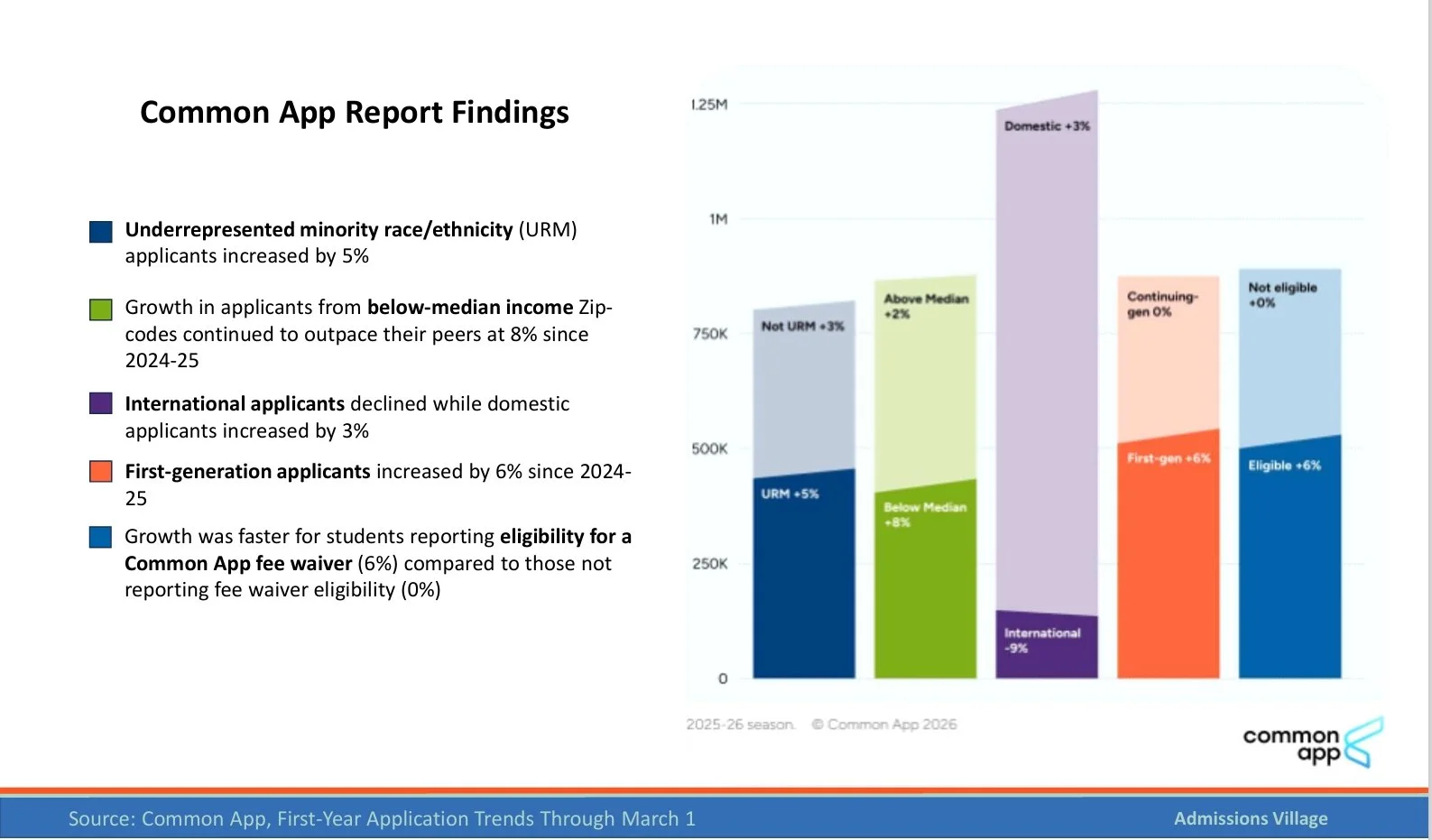
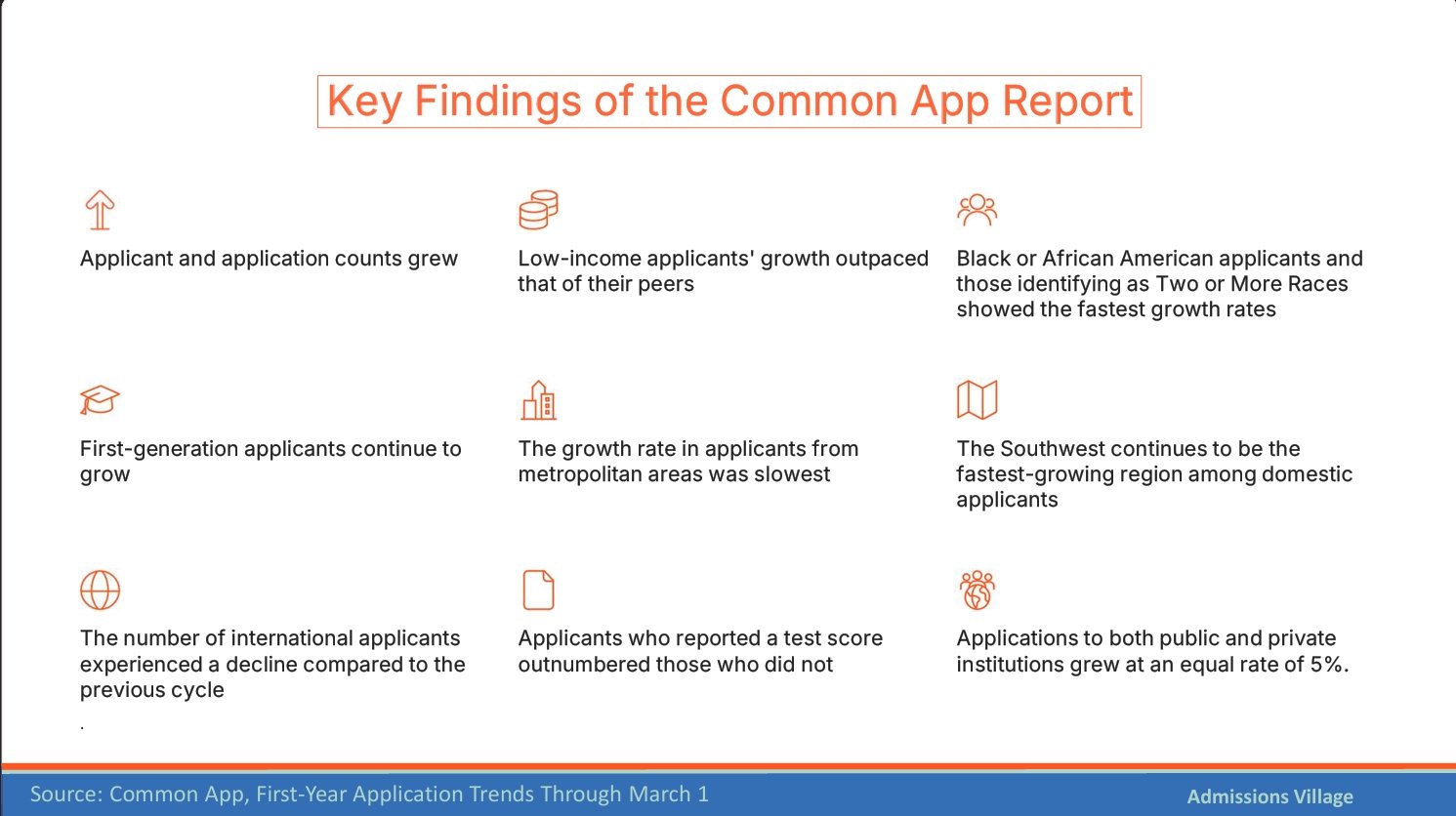
Many colleges continued to experience record or near-record application volume while others struggled to fill seats. For highly selective institutions, the enrollment cliff is largely irrelevant to their application volumes and we expect those colleges to stay just as, if not more, selective next year. Yet, we keep hearing about more colleges closing. Many places are really struggling, especially smaller colleges, regional institutions and even some community colleges. In the last ten years, over 120 colleges and universities have closed or merged. Penn State has seen enrollment decline 35% or more over the last ten years at several of its branch campuses while over the same time period its University Park campus is up 5% in enrollment. Penn State is considering closing seven of its regional campuses. Just recently, Hampshire College announced they will close and immediately many colleges swooped in to say they would welcome Hampshire students, a sign that many colleges have unfilled beds.
We have heard estimates that over 100 colleges will close in the next few years. The Huron Consulting Group estimates that close to 400 colleges could close or merge in the coming decade, possibly displacing around 600,000 students. According to a recent paper from the Federal Reserve Bank of Philadelphia, about 60 are closing on average each year; that number could double in any given year if the bottom falls out of enrollment. If it seems like our numbers are confusing it is because they are. Different sources count college closures differently. In a 2024 blog post from Robert Kelchen linked here, he discusses why people count closures differently and which sources are the most accurate. When a college closes or renames branch campuses, should that be considered a closure? Regardless of how these closures are being counted we are losing a lot of great institutions and particularly regional and local options.
This affects not just students at those colleges that are closing. It has a ripple effect that goes much further. Many of these colleges are located in small towns and cities where the college is the primary employer for that area and its students are a huge source of revenue for local businesses. Colleges often serve as the cultural heart of the community with performances and art exhibits, which can also attract newcomers and retirees to the community. Closures will lead to the demise of many small towns and cities and fundamentally change the ethos of small town America. These closures also affect admissions at the colleges who are still thriving. For example, Villanova took over the Cabrini campus last year and opened up 900 seats for their students going forward. Despite Villanova receiving a record high number of applications, their acceptance rate rose by about 2% to 29.6% according to College Navigators because they were targeting an additional 230 seats for this year.
While international applicants were down overall 9% this year, their application numbers were fairly stable at the most selective institutions. The Chronicle of Higher Education reported that international applications increased as school’s selectivity increased while applications to the lowest two selectivity bands declined almost 20%. More international students are applying to top institutions since tracking began in 2021, and the selectivity gap is growing. For example, Tufts had its third largest year ever of international students applying for admission.
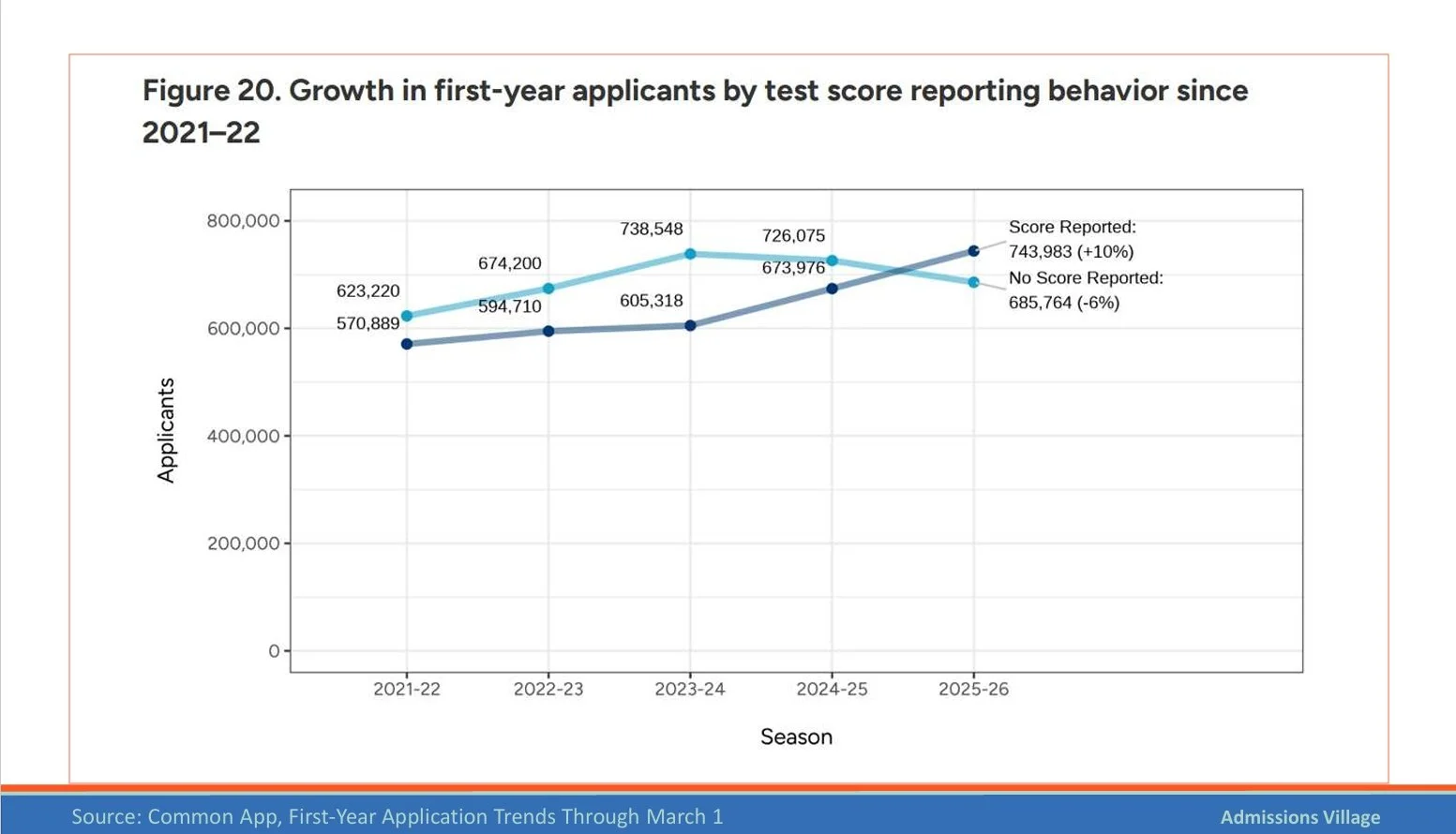
We are seeing a slight increase in the number of students who are taking standardized tests.
This past cycle, for the first time since the pandemic, more students chose to submit test scores than not.
Low-income, underrepresented minority and first-generation students remain less likely to report test scores.
All the Ivies except Columbia now require test scores. WPI moved from test blind to test optional. Purdue is technically test-optional, but they told us two weeks ago, they are “test expected.”
Regional location often impacts testing policies for public institutions. Southern selective colleges are often more likely to require scores. LSU is the latest to add themselves to the list of colleges requiring scores. Each time another college becomes test required it drives test submittal rates up everywhere because more students already have a score.
Colleges are increasingly looking for scores because in the world of grade inflation, transcripts are difficult to compare. UC San Diego, a part of the University of California system which is test blind for SAT and ACT exams, is saying their incoming students can’t do math. We would not be surprised to see the UC system become test-optional, instead of test-blind, at some point in the future.
Requiring scores or incorporating them into the review process also aligns with the reality that some highly selective universities may have agreed to report admissions data to the federal government or they feel their admissions decisions will need to hold up under scrutiny.
However, some colleges, like Wake Forest and Bowdoin have been test optional for a long time, while University of Delaware recently announced they are remaining test optional indefinitely.
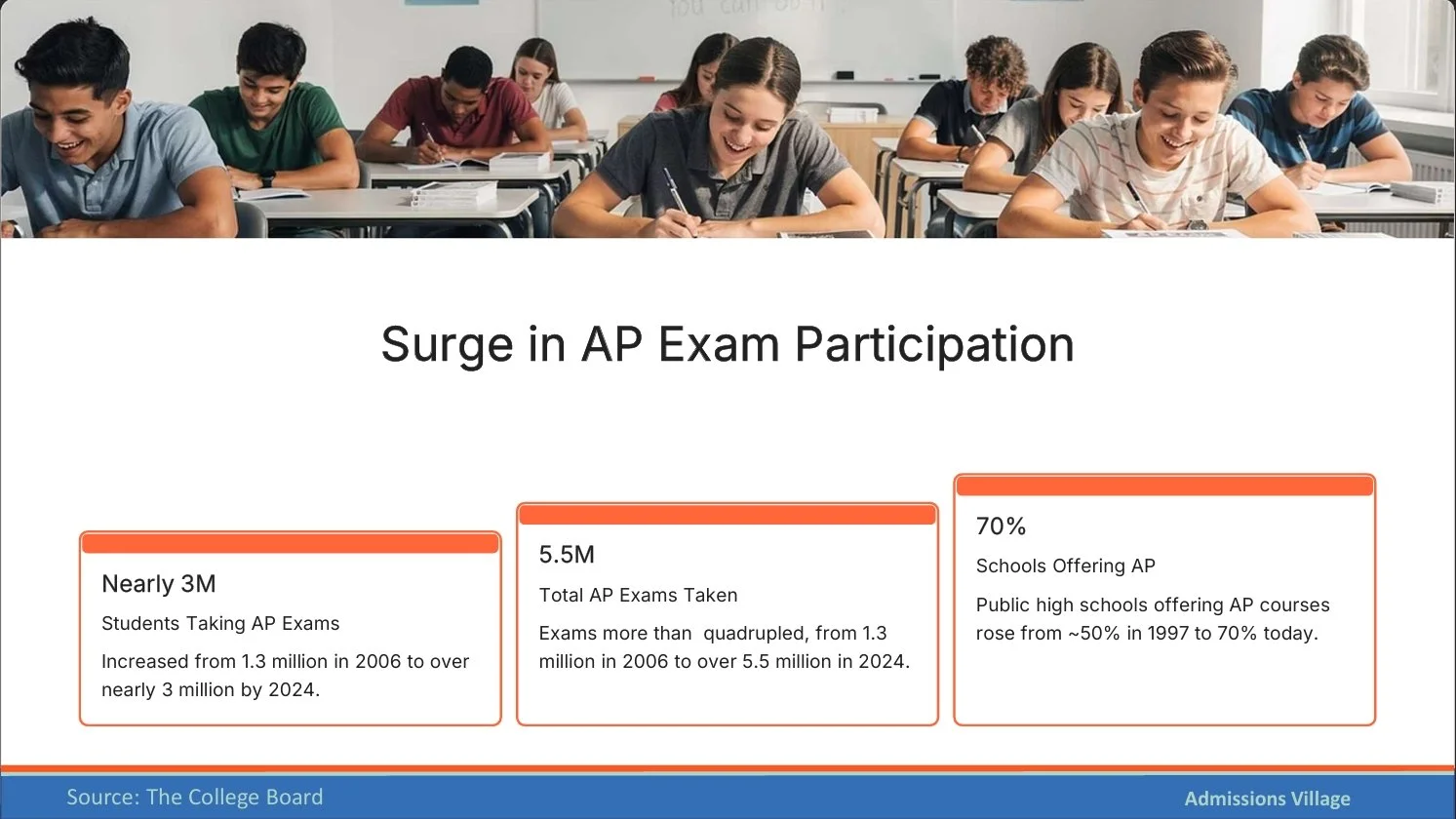
Colleges are increasingly looking at AP scores to show mastery of content in a time of grade inflation.
Emory says they look very closely at AP scores. The UC system is test blind but only for SAT and ACT scores. They review and value AP scores as part of their admissions process. Then there are a group of colleges like Notre Dame that have told us they are test optional, but they are not quantitative evidence optional- meaning they prefer test results of some kind.
There is also a growth in AP class offerings. The College Board is creating new classes like AP Cybersecurity, AP Networking, and AP Business with Personal Finance, among others. This aligns with colleges wanting independent metrics, but we also need to remember that the College Board, who is responsible for APs, is also a business with tremendous revenue from AP exams.
We are seeing some colleges like Caltech require AP scores from students who have taken the courses, instead of letting the reporting of AP scores be optional, and we are seeing some colleges like Yale whose test-flexible policy allows for AP scores instead of ACT or SAT scores.
In the last approximately 30 years there has been a large increase in the number of high schools offering AP courses. Today roughly 70% of public high schools in the U.S. offer AP courses today compared to about 50% in 1997.
Why are Tests Coming Back into Importance?
We have spoken before about how grade inflation is rampant in this country. This has become much more widely known and post pandemic there is greater awareness that grade inflation is damaging to students. According to The Hechinger Report, in February of 2026 “A new study delivers an uncomfortable answer. It finds that lenient grading, or grade inflation, is actually harming students, leading not only to worse academic outcomes but also reducing their employment prospects and future earnings.” When kids miss learning material, or how to stick with challenging subjects to gain mastery, they are losing opportunities to learn how to work hard. Knowledge gaps follow them into the workplace, eroding confidence and performance.

Back to Our Theme: Time
As you can see from the above chart, early applications have now surpassed regular decision applications. It is almost as though if you are not early, you are late as many colleges in an effort to yield the class they want, give away the vast majority of their seats and money in their early rounds. (Please see some of our past institutional priorities blogs for some examples of colleges that admit the majority of their students early.) Each year we see more colleges adding early deadlines. Next year WashU and Connecticut College are adding Early Action and University of Southern California is making Early Decision available for all of their majors.
This is a Low Moment in Time for Public Confidence in Higher ED
From the recently released report of the Committee on Trust in Higher Education Yale University, “Just a decade ago, 57 percent of Americans expressed “a great deal” or “quite a lot” of confidence in higher education. By 2024, that number had dropped to a historic low of 36 percent. While trust improved slightly in 2025, seventy percent of Americans still say that higher education is heading in the wrong direction.”
“Our committee identified three immediate factors behind the rise of public distrust. The first involves the soaring price of higher education in the United States, along with the perception that college, graduate, and professional school are no longer worth the money and sacrifice they demand. The second focuses on the college admissions system—specifically, the question of who gets in and why. The third includes an array of issues about what is said and taught on university campuses, including matters of free speech, political bias, and self-censorship. We also found important problems related to trust within the university itself, including concerns that grade inflation, new technologies, and bureaucratic expansion have undermined the university’s academic mission. The range of topics revealed another challenge related to declining trust: widespread uncertainty about the fundamental purpose and mission of higher education.”
Let’s unpack this a little bit - of course people are distrustful. While the cost of many colleges has gone up we continue to see colleges tightening their belts with many cost-cutting measures.
Programs and majors are being cut or changed because of politics and low enrollment/lack of interest - For example: Syracuse had a significant restructuring in early 2026, announcing the consolidation, pause, or elimination of nearly 100 academic programs.
Colleges are also cutting costs in less obvious ways: On our recent tour of midwestern colleges one of our students at UChicago told us the dining hall closes much earlier on Saturdays and has more limited food choices. She said instead of having an adult resident director who lives in every dorm, now there is only one for every four dorms. At Northwestern, after a $790 million federal funding freeze, they decided to eliminate their annual winter holiday lights on campus trees and buildings. And at one super-selective college, it was plainly obvious they had decided to cut back on their landscaping costs. On the academic side some colleges are getting rid of adjunct professors because of financial pressures or they are adding more adjuncts to cut costs. Students at almost all of the colleges we recently visited spoke about being taught by PhD students. This can be a future concern as PhD programs are being cut and scholarships for grad programs have been limited.
According to Forbes, “Tenure is in a long-term decline in the US, with tenured faculty dropping from over 50% in 1975 to roughly 1 in 5 today.” Tenure dying is a cost-cutting measure, a response to political pressure and a fundamental change to the philosophy of higher education.
Lastly, the rise in AI has people questioning the value of higher education and further complicates the college admissions process as more admissions offices are starting to use it in some way in their application reviews. We are seeing a lot more AI majors and minors and revamping of curriculums to incorporate AI. We hope we will also see a return to humanities majors as the rise of AI is highlighting the need for soft skills.
How We Saw This Affecting Our Admissions Village Students This Year
Overall we saw a lot of these trends affect our own applicants, who had a great year. Many of our students chose less expensive options for college this year over more selective, more expensive options. We even saw students turning down the very most selective colleges that have acceptance rates under 20%. There was a very small reversal of grade inflation. We had 12 students with a C on their transcript last year who outperformed how they would have done with admissions just a few years ago. For a few years post pandemic we did not see any Cs.
Despite the demographic cliff, applications are up at highly selective colleges, especially at the large public, southern and apolitical schools. We had more Texas colleges on our college list than ever before. The increase in interest in large state schools, even if it’s not a student’s own state, is impacting other trends we are seeing, like more states moving to auto admit for top 5-10% of instate students, which limits out-of-state spots even further. We also saw the use of pathway programs to ensure a pipeline of students into these schools after the first semester or first year, which also keeps admit rates lower as students who matriculate into a college via these Pathways do not need to be reported in a college’s admissions statistics.
We saw more spring admits and more alternative campus admits. For the first time ever, Vanderbilt offered a select group of students a Verto year abroad start and the 120 student cohort filled in less than 24 hours. Not including colleges that have community college pathways, some colleges that offered guaranteed transfers this year are George Washington, University of Georgia, Cornell University, Boston University, Georgia Tech, University of Southern California, Georgetown, and Northeastern University.
We also saw an increase of colleges deferring students from the early round to the regular round, especially for students who did not have a straight A transcript or who lacked a standardized test score. This could be attributed to more colleges sorting by AI initially. Then there were cases like U Michigan’s ED round this year, where we believe they simply did not get all of their apps read in time so they deferred most of their ED applicants only to admit a group January 5th and then another group in the EA round later that month.
We saw the continuation of colleges carrying large wait lists and moving to those waitlists earlier than ever before. University of South Carolina, UChicago and UMiami have already moved to their waitlists.
In addition to more early applicants and deadlines we saw colleges come back sooner with decisions. Colleges are trying to lock kids into a decision earlier as the environment is more competitive not just for you, but for colleges as well.
We saw colleges adding a sort of quiet ED3 round by quietly offering to switch to ED in March.
Colleges added new ways to measure interest - A few weeks after its deadline, Lehigh asked all of the students who had submitted an application to send in a song for their reading playlist. (They coincidentally received a historic high number of apps this year).
Colleges gave more and bigger merit scholarships-
We saw students choosing to play DIII athletics because they were offered huge academic merit scholarships at those colleges. We believe changes in Parent PLUS loans are partially responsible for this as colleges feel an increased need to compete with each other financially.
We also saw colleges giving merit aid this year that we have never seen this from before, like Holy Cross, Reed and Trinity College. Some colleges independently raised that amount before and after students had made a decision. This has been happening for a few years now, in part because the DOJ issued an antitrust directive that was meant to stimulate competition between colleges after the Varsity Blues scandal in 2019. Our families had more luck appealing for more merit money, with more schools willing to negotiate.
Families are being more conscious of what undergrad will cost them and what they can realistically afford, due to upcoming loan limits, especially when grad school is likely to be involved. We saw several top students this year opting for Honors Colleges at State Universities and more affordable or full rides options over more selective names. We have current college students choosing to shorten their time to graduation, which they are able to do because they have taken so many AP and dual enrollment classes in high school. Some other students are forgoing private 4-year colleges to enter community college which is backed up by a national rise in community college students
We have also seen an increased interest in UK and Canadian schools as more affordable options and as students want to avoid more holistic admissions, and American politics.
Increasing use of AI both on students' parts and college admissions offices, even among our colleagues and peers. Interestingly we saw more colleges asking for supplemental essays, not less, with the exception of a couple of places like UVA.
We saw increased uncertainty about jobs after graduation, in part because of AI, which led to increased grad school apps.
Trends in Law and Medical School Admissions
This uncertain job market is probably one of the reasons that this past year’s admissions cycle for both law school and med school - which are just now ending - saw an increase in applicants.
For law school, this continues a trend from last year, so the increase in applications over two years is very significant. Applicants are up almost 32% compared to just two years ago. Not only are there more applicants, but applications are up 38.3% during the same time period, meaning each applicant is submitting more applications than ever before. And for medical school, applications increased this year for the first time in a while, up 5.3%. In a hopeful sign, though, spots in med school are increasing as well because new med schools are opening and existing ones are expanding their classes.
One result of this is that median test scores and GPAs for accepted applicants are rising as well. This past fall, 28 law schools had LSAT medians of 170+ (compared to only 5 schools with such high medians in 2015). 91 law schools had LSAT medians of 160+ (compared to 49 schools with those medians ten years ago). Mean MCAT scores for matriculants climbed in the 2025-26 cycle, reaching 512.1 (compared with 511.8 the previous year). High scores are increasingly important,not only for admission but also for securing merit-based financial aid.
If you think you want to go to law school or medical school, our advice is to (1) focus on getting good grades during college and (2) allot enough time before the application cycle to study for and re-take standardized tests.
It’s still unclear how the new federal loan caps which were discussed above are going to play out, but there’ve been predictions that over the next couple of months, as schools turn to waitlists to fill their remaining seats, there might be more waitlist movement than usual because some accepted applicants are going to crunch the numbers and realize they simply can’t afford to go.
Keep reading to learn in Part 3 what prospective undergraduate and graduate students can do to help themselves in the current landscape.