
Trends in Admissions and Higher ED, Part 3 - Students Should Follow One of Two Pathways
Since we just finished with trends in law and medical school admissions, we’ll start with them as we explain what students can do to best prepare themselves for today’s environment.
Timing - When to Apply to Law and Medical School
Time is a big factor in med school and law school admissions, on two fronts. First is the timing of when, in your life, to apply to grad school. For multiple reasons, gap years have become the norm rather than the exception for both law school and medical school. At Harvard Law, 84% of entering students last fall were at least one year out of college, with 69% at least two years out. Law schools are very concerned with their graduates’ employment outcomes, and they know that employers like to hire candidates who already have solid work experience. Recruiting for law firm jobs has now moved up to the first year of law school, which means the resume a student has on their first day of law school is basically the resume they’ll be applying to jobs with. Gap years not only give students time to build resumes that help them get into law school, they help students get jobs after law school as well.
Likewise, the average age for University of Rochester Medical School's incoming class this past year was 25. Medical schools look very closely at the number of hours each applicant spent on various activities. If you work full time during a gap year, you can get something like 1,500 hours per year of clinical or research experience – a number that would be incredibly difficult to match while still in college.
We advise applicants to start planning for gap years early on so they can pace themselves throughout college, balancing activities and academics and not spreading themselves too thin.
Time is also a big factor in law and medical school admissions. When in the admissions cycle to submit your application is critically important. Both med school and law school use rolling admissions. A common mistake is thinking you just need to submit by the application deadline. But by that time a lot of the acceptances have already gone out. So what we usually advise applicants is to submit as soon in the admissions cycle as they can without sacrificing the quality of the application (including potentially higher scores, better recommendations, or better essays).
So, Back to How Do We Advise Our Students Applying to College in this Current Landscape?
First take a deep breath and be patient. This starts with being patient with yourself. This is your own process - try not to compare it to what everyone else is doing and stick to your own timeline and agenda. Recently Aly read an article by an anonymous author and they said, “Comparison is the thief of joy, and the algorithm is its accomplice.” And there’s actually research to back this up. Stanford University paid 35,000 students to quit social media for 6 weeks and found that participants’ levels of anxiety and depression decreased while overall happiness increased So what does that mean? Stay off social media! Every year we see students looking at Instagram posts of where students have decided to attend and they accept at a college to be done. That is not what you should be doing. You should only accept your spot once you are in love with where you are going. That hurry to post really stresses everyone out. You will change a lot throughout this process and the school that you always thought you loved in 9th, 10th or even 11th grade might not be the right one for an 18 year old you. You need to play the long game here just like the colleges have been doing. That means careful, slow planning. Please realize this process is a marathon, not a sprint.
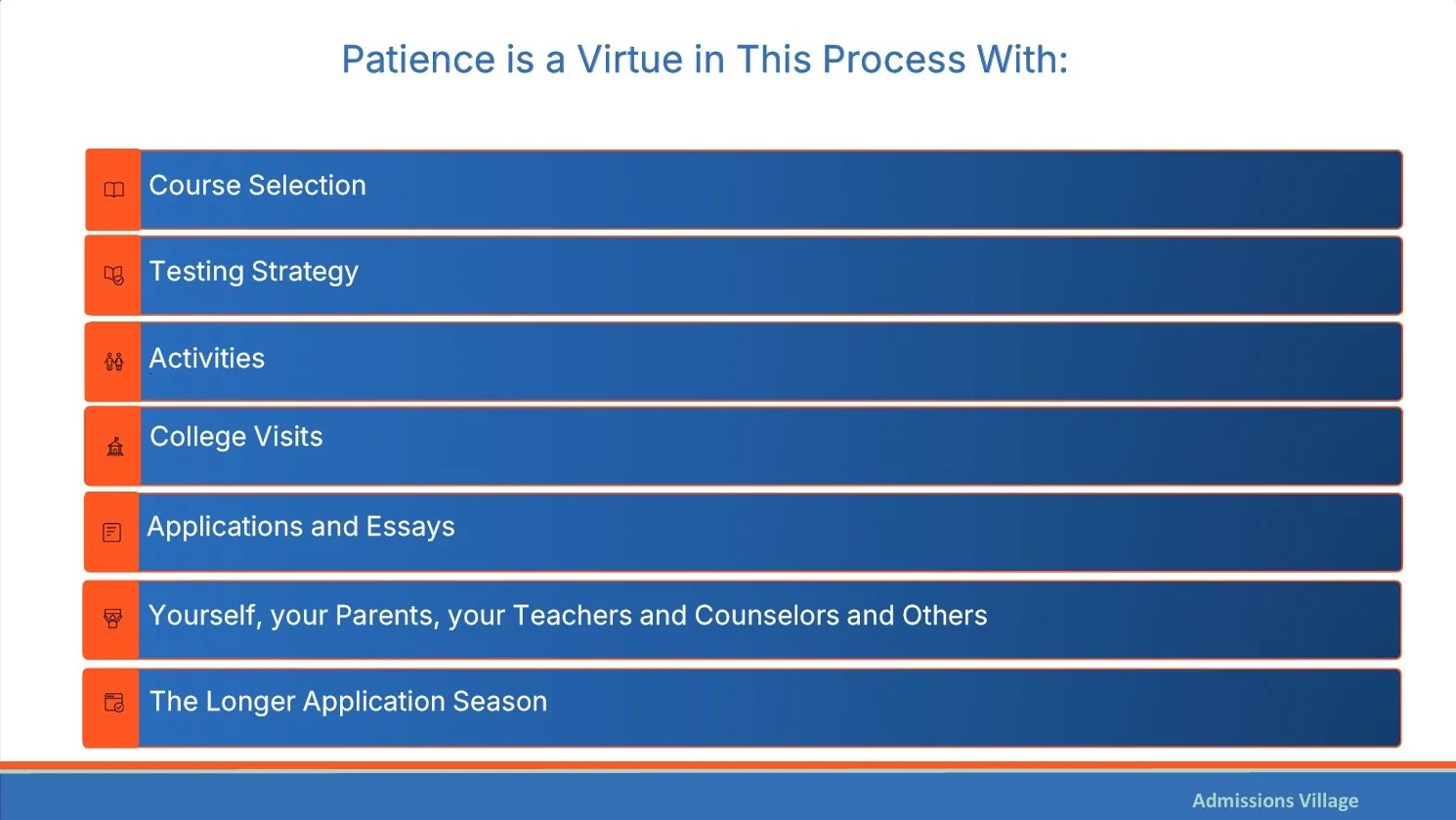
Course selection: What does it mean to be patient with your course selection? Be thoughtful, not reactive. Course selection is not about taking every hard class, it’s about taking the right level of rigor for you and building toward long-term goals. Decisions made early in high school, like math placement, matter because they shape future opportunities. For example, reaching calculus is important, if you want highly selective business or engineering programs. Although keep in mind colleges will always evaluate you in the context of what is offered at your high school and some high schools do not offer calculus while some offer classes past calculus like linear algebra or multivariable calculus. Most importantly do not overwhelm yourself early on. Strong grades in well-chosen courses matter more than overloading and burning out.
Testing strategy:There’s a lot of urgency around testing, but the most successful students take a slower, more intentional approach. Starting prep too early often leads to burnout or plateauing, the goal isn’t to finish quickly, but to do it well. Most students should take SAT and ACT diagnostics at the end of 10th grade to see which suits them best, there’s no admissions advantage to either. In 9th and 10th grade, the focus should be on strong fundamentals, good grades, and the right level of course rigor. When prep begins, it’s about strategy and performance, learning how to take the test and timing it when you’re confident and ready. Some of our students have actually scored higher in early senior fall than in spring junior year. Because they’re more mature, more confident, and better prepared. Colleges don’t care when you take the test. They just see the score.
Activities: Activities will and should evolve over time. They do not need to be fully figured out early. There is no magic formula. You DO NOT need an internship in high school. What really matters is simple: What do you care about, and what have you done about it? The strongest applications come from students who genuinely engage in what they enjoy, not what they think will look impressive. Comparison is the thief of joy, and it’s especially dangerous here. Another thing to consider is that your activities should align with what you want to study. They are the evidence for colleges that proves to them you understand what you want to study and that you will be successful doing it. The goal is not to build a “perfect” activity list, it’s to build one that reflects who you are and positions you to thrive in the right college environment.
College visits: Be intentional and start early. With more students applying early, it is best, if you can afford it, to visit before you apply, not after, and ideally when students are on campus. This is the best way to understand fit. Look beyond big, impressive facilities, these can sometimes mask weak advising or limited support. Smaller schools may feel less exciting at first but could ultimately be a much better fit. Additionally, visits are also one of the strongest ways to demonstrate interest, especially at schools that track it. For example, Elon University has seen 10x higher yield from students who visit in person and 1x higher yield for virtual visits than if they have not visited at all. Even at highly selective schools with the highest yield rates, visits are important because they help you write stronger, more specific essays. A few quick tips: Try to tour in the afternoon to get a better feel for campus life. Campuses are still kind of sleepy in the morning, even during the school week. Be mindful that factors like weather (as noted in recent research from Amherst College) or even doing back-to-back tours can influence your perception. We know visits can be hard to schedule and expensive, but, when possible, they are worth it.
Applications and essays: These take time, a LOT of time. Strong applications and essays require: reflection, iteration, and multiple rewrites. This is not something you want to rush. Students who give themselves time to think and revise always produce better work.
Be patient with yourself, your parents, your teachers and counselors and others: This is a hard and stressful process. Most people are trying to support you and truly have your best interests in mind but they are also busy and can not always priortize you at any given moment. Try to carefully plan out the work you need to get done in this process and not to leave things until the last minute. This will lead to the best results and also keep you happiest and calm.
Longer application season: The process is longer now. With deferrals and waitlists being utilized more, your final decision could potentially drag past May 1st and into the summer. Again, this requires patience. Honestly, we often see that those students who are in this process the longest are the happiest in the end.
So what else can students do?
Maybe students should also have two pathways in admissions. This part is really critical: While applying early can improve outcomes, the right kind of early depends on your goals. If your priority is maximizing your chances at more selective schools, then being decisive and applying ED or REA can be a strong strategy. If your priority is maximizing your financial options then patience becomes even more important. Applying EA or Regular Decision allows you to wait, compare offers, and potentially negotiate for better financial packages. Keep in mind this might take a while and potentially even bring you past May 1st and colleges take a while to work through financial aid appeals. The key is understanding that there isn’t one “best” strategy; there’s the one that aligns with your goals. And that requires patience.
Why did we explain all this to you?
Our goal is simple: to help you look beyond acceptance rates. Because colleges today are following different pathways that lead to different enrollment strategies. Many are navigating real financial pressures behind the scenes. When you understand how the system actually works, you can make better decisions and feel more certain that they are right ones for you and your family.
Last, I want to go back to timing.
This is a scary time for kids and their parents- everyone is worried about if their student will get into a college they want, if they will like that college and then the bigger worry will they get a job in this new AI world. Please take a minute and breathe. Every time there is a major new technology jobs shift and change. Old ones do disappear but new ones replace them. Think about this. Why are you going to college? It might be about return on investment to get a job but we like to think of it as a return on investment in yourself. College is the gift of time. The time to learn and grow and figure out who you are and what you want to do in this world.