

Blog

What Classes Should I Take Next Year
What classes should I sign up for next year?
Now is the time of year many high school students are deciding which classes to take next year. What classes a student takes is often a big factor in college admissions decisions.
1. All students should take a challenging course load. This is especially important to do in subjects you are considering pursuing in college. While colleges like students to take rigorous courses they also want you to show maturity and not take on more than you can handle. In general, challenge but do not overwhelm yourself. Take classes where you can get a B or higher.
2. Colleges like you to continue to take classes in all 5 core subjects all 4 years. English, Math, Science, History, and Foreign Language. Highly selective colleges expect you will take all 5 subjects all 4 years. These days they want poets to be physicists and engineers to write poetry, even better if they write poetry in a foreign language.
3. Take classes in subjects that interest you. Colleges like to see you dive deep into areas of interest, especially if you are considering them as a course of study in college. Also you will always have better results in classes you want to take.
4. This is a general guide and you should adapt this as it is right for you.
So what does this really all mean:
Most colleges would prefer to see a B in an AP or Honors class versus an A in an easier class.
The more selective the college, the more rigorous your course load should be when applying. For example, highly selective colleges like to see students with at least AP Calculus AB and Physics, even those students not studying STEM fields. Business Schools want students to have taken Calculus and Statistics.
Highly selective and selective colleges expect students to take the most rigorous course load their high school offers. That means a lot of APs if they are offered at your high school. Colleges usually get a school profile from your high school and they will realize if your high school limits how many APs a student can take and when they take them. Or for that matter if your high school does not even have APs. That said, to give you an idea, the middle 50% of accepted students at the University of Georgia have taken 7-12 APs. We have heard at some even more selective colleges the average number of APs for accepted students is even higher.
Foreign language is better if it is the same language all 4 years. For highly selective colleges it is good if you can get to at least the AP level of your foreign language.
Sciences with a lab component are more rigorous than Sciences without.
If you really hate language and are terrible at it, most colleges only require 2 or 3 years of a language.
The last thing to keep in mind is that classes you decide to take earlier in high school, often determine what courses you will take as you progress through the years. It is hard to jump from all regular classes freshman year to all AP courses senior year. Try and think of your long term goals at the beginning of high school and plan accordingly.
Please reach out with any questions.
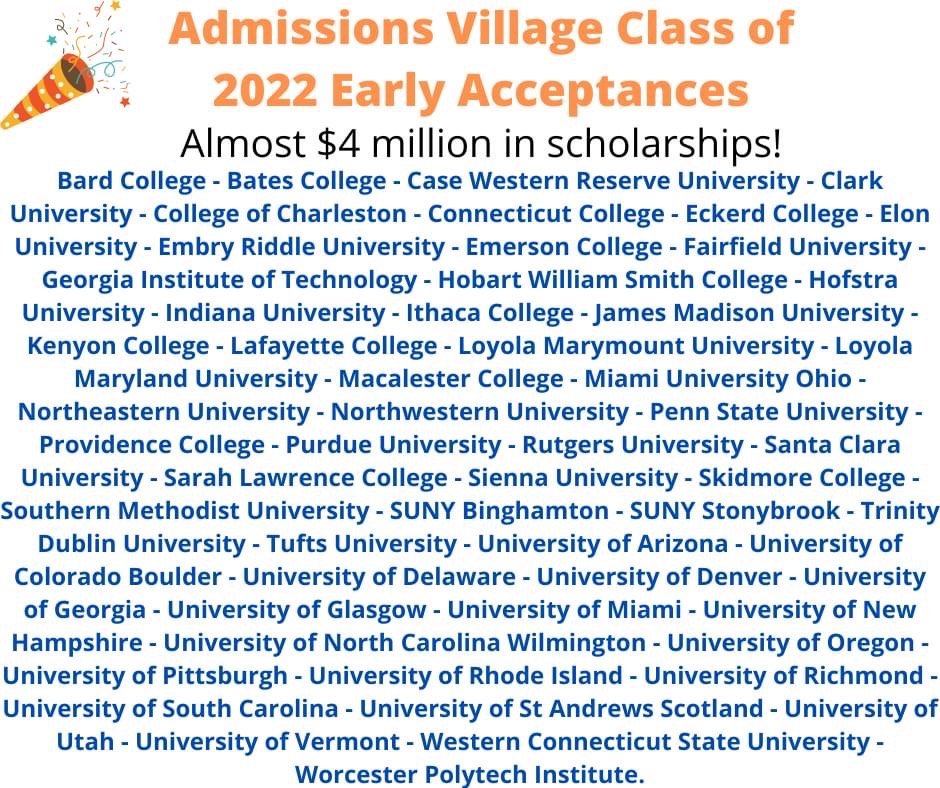
It Takes A Village
We are so proud of our students. Here are early acceptances for our class of 2022 so far.

So You have been Deferred…
What to do when you have been deferred from your ED or EA college?
First, if you found out in December, take a couple of weeks to think about whether this is still a college you would like to attend. If you find out in late January or February, please email them back asap, as you will not have much time before they consider you in the regular admissions round. If you have already found out and take a couple of weeks, this will give you time to get over the disappointment of not getting accepted outright, and it also gives you a few weeks to think about why this college is still right for you. Maybe you have been accepted somewhere else you prefer since you applied a couple of months ago? If you are NOT still interested in attending the college, you have been deferred to, send a letter to your admissions rep and ask them to please withdraw your application. If you are still interested, then it is best to follow instructions on what the college has asked you to do to show this. Usually, they would like you to add some information to their school portals like first semester grades and any new test scores. I like all of my students to also send their admissions rep a letter of continued interest (LOCI). The best thing is to email this letter to your admissions rep and also upload it to your admissions portal. Some colleges, like the University of Georgia, specifically ask you NOT to send them a LOCI, so please pay attention first to what a college asks for. Most colleges, though, will like you to write a LOCI.
So what should be in this letter:
1) I like you to start with that you have taken some time to think about being deferred from X college and that you are more convinced than ever that X college is still your number-one choice or, in the case of EA, a top choice.
a) Go to a college’s mission statement, if you have not done this in the original application, for why you and X college are a great fit.
2) Make sure to have your high school send your first semester grades. If you don’t have the official GPA transcript yet, that’s ok. Tell them what you think your semester grades will be in a few weeks and that your high school will send them when they are official. Make sure to tell them this is your guesstimate of what your grades will be.
3) Provide admissions with any new information. If you do not have any, highlight some recent academic work, especially if it pertains to what you want to study at X college. This is very important. You should try to include new academic information and also any new information about your extracurriculars. In the words of my colleague Evan Forrester, this is the “heart of the email.”
4) If you are not doing anything new, maybe now is the time to start, and then you have something to talk about.
5) In the final paragraph, ask if you can do anything to further support your candidacy for admissions.
6) Thank the admissions rep for taking the time to read your email at such a busy time of the year.
7) Last and very important, reiterate how much you would like to attend X college. If it is your first choice, repeat that emphatically with a “and if I am accepted, I will attend!”
Now what are some additional things you can do to bolster your chance of admission:
1) If a college will allow it, send in an academic paper from the first semester.
2) If the college will allow it, send an additional recommendation. Maybe you have a teacher who can highlight a new side of you. For example, last year, we had a top student applying to study Economics. He also happened to be one of the best writers I have ever worked with. He realized through the college process just how much he enjoyed his writing and said as much to his ED college, where he has been deferred. He got a new recommendation from his English teacher and added that to his admissions portal. Not saying it was the additional rec, but he was accepted in the regular round.
3) If you can visit the college you have been deferred at, even if you have visited before, VISIT! We realize during COVID this might not be possible or even without COVID feasible, but it is a very effective way of showing how interested you are. Make sure to let your regional admissions rep know you are visiting and ask if you can see them to introduce yourself in person quickly. If you can not do an in-person visit, try and do some more virtual visits; make sure to follow them on social media and make sure to click through often to their website. Getting deferred from EA especially is often all about yield (who will actually accept a college’s offer of acceptance). Getting accepted in the regular round is also often about yield, so showing as much demonstrated interest as possible is VERY IMPORTANT.

What To Do When You Have Been Accepted to Your ED College.
Congratulations! You have been accepted to your Early Decision college!! We are happy for you. You should be so proud of all your hard work to get to this point!
What should you do now?
1) Celebrate - a lot!!
2) Next, you must remember that this offer is binding. You have committed to attending this college if you are accepted. So first, you must triple make sure you can afford it. If you have applied for financial aid, please check your offer before taking your spot. Finances would be the only reason you might be able to get out of an early decision acceptance. If a financial offer is not what you expected, please reach out to the college’s admissions office before accepting your spot. Maybe there is something that can be done to make this college affordable for you.
3) You should officially accept your spot in the Class of 2026. Read your acceptance letter for how to do this for each college, but it is usually done through your application portal and involves submitting a deposit.
4) You now must withdraw all your other outstanding applications. We understand it can be tempting to know where else you are accepted, but you have promised to attend your ED college. You must withdraw your other applications. Look at it this way; it is also the “right" thing. You know you are not going to accept a spot at those colleges. Someone else is waiting on a decision from there. It can be their dream, and by withdrawing your application, you might be clearing the way toward their acceptance. So how do you withdraw your other applications? Many colleges will let you do this right in your application portal. If they do not, you should send a short email to your admissions representative and cc the general email to the admissions office. The email should look something like this…
Subject: Wonder Woman application withdrawal
Dear Mr. Awesome Admissions Rep,
My name is Wonder Woman, and I applied to the Marvelous Marvels University regular decision. I am writing to you to please withdraw my admissions application. I have been accepted to another university (you do not have to tell them where you are going unless you want to) early decision. Thank you very much for your time and consideration.
Sincerely,
Wonder Women
Application Number 11111
5) Please let your school counselor know that you have been admitted ED, withdrew your other applications and deposited and accepted your spot at X University.
6) Please let your teachers and other recommenders know that you have been accepted and thank them one more time for all of their efforts on your behalf.
7) KEEP YOUR GRADES UP!! Acceptances are usually conditional on keeping your grades commensurate with where they were when you applied.
8) Keep checking your email. Your new college will be sending you lots of communication in the next few months. There will be deadlines that need to be adhered to.
9. Lastly, join a Facebook group for your new university Class of 2026. Start meeting your future classmates. Parents: there are usually Facebook groups for you too, and they can be a great source of information and camaraderie for you.
10) Back to Celebrate!! Buy a t-shirt, a baseball hat, a sticker for your mom’s car, or your grandpa a sweatshirt. It is a gift to be done with this process in time to have a truly Happy New Year!!

Tests and the Rest IEC Profile
Thank you, Amy Seeley and Mike Bergin, for featuring me on your "Tests and the Rest" podcast. It is always great to speak with you both.

FAFSA VS CSS PROFILE
Federal Methodology, as expressed in the form “FAFSA,” is used for awarding federal student aid. Any student who wants to be considered for federal aid must complete a FAFSA form. Applying to FAFSA is free. The FAFSA looks at students’ and parents’ (if a student is a dependent) financial information to determine what they can afford to pay, the EFC (Expected Family Contribution). They consider income, taxable and non-taxable, and assets for both students and parents and use that information to award federal and sometimes state grants and loans. This form is directed at students even when parents also fill it out. They provide some allowances for parents and students based on things like federal and state taxes paid and how many children are currently in college. There are some adjustments, but things are not dollar for dollar. FAFSA excludes many significant assets from their calculations, including but not limited to retirement accounts, equity in a primary home, and equity in a business that has less than 100 employees. FAFSA is for US Citizens or eligible non-citizens.
Institutional Methodology is calculated using the CSS Profile. About 170 institutions require the CSS Profile. The list of institutions is here, but it is always best to verify with the institution: profile.collegeboard.org/profile/ppi/. It costs $25 for the first school it is used for and $16 for each additional school unless a student qualifies for a fee waiver. It is directed at parents. It was created and is processed by the College Board. CSS Profile is used to determine what families can afford to contribute to their child’s college costs, EFC. This will not be the same EFC number arrived at by FAFSA as the two methodologies have some very different ways of calculating results. It will also consider income taxable and non-taxable assets for both students and parents and use that information to award institutional aid. It is how income and assets are considered where these two methodologies come up with different results. The CSS Profile, first of all, expects students to contribute to their education. Not only do students lose the $6,840 income allowance that FAFSA provides them, CSS Profile expects them to contribute $2,000 a year to their education. CSS Profile also gets much more into the parent’s finances. They consider equity in their primary home, annuities, and equity in a business with less than 100 employees to be assets important in calculating EFC. CSS also considers the financial information of both parents and potentially four parents in cases where a child’s parents are divorced and remarried. FAFSA only considers financial information from a student’s primary parent. Generally, the CSS Profile wants more information than FAFSA on what is your family’s financial considerations. This can both work for and against you in seeking financial aid. It can work for you in cases where the CSS profile will also consider if your family has had extenuating financial expenses. For example, loss of employment and extensive medical or dental expenses, or some schools will also consider if a family has a younger child in private school. Both CSS and FAFSA consider if a family has other children in college. Just a head’s up, but that is due to change for FAFSA next year. CSS Profile can get filed by anyone looking to become a student at a school that uses it, including international students at most schools. CSS Profile often looks at a family's savings and equity in their home and expects them to contribute a huge amount to their children’s education. It makes private college unaffordable for many families unless their student also receives some merit aid.
Lastly, both FAFSA and CSS Profile are open for filing as early as October 1st, but they have different deadlines that they must be filed by. FAFSA must be filed by June 30, and CSS Profile has different deadlines in line with each school.

Show me the Money
It is almost October 1st which in college admissions means it is nearly time to start filling out any financial aid forms you need. For those less familiar with the financial aid process, October 1 is the first-day families can access, complete, and submit the 2022-2023 FAFSA (The Federal Application for Free Student Aid) and CSS Profile. Anyone logging in sooner will be completing forms for the wrong school year.
If you are applying for need-based financial aid, you will need to fill out a FAFSA and possibly a CSS Profile for all schools where your child is applying. Please complete the FAFSA as close to that time as possible. From the official blog of Ed.gov:
If you want to get the most financial aid possible, fill out the FAFSA form ASAP. Some financial aid is awarded on a first-come, first-served basis, and some states and colleges run out of money early. Even if it seems like your school’s deadline is far off in the future, get your FAFSA form done ASAP. The 2022–23 FAFSA form requires 2020 tax information, which you should already have—so there’s no excuse to wait!
Let’s start with what you will need for FAFSA. In most families that we deal with, children are dependents of their parents. We will assume you are, too, and if you are not reaching out, we can discuss how the process will change for you.
Let’s gather what we need. You and your parents will need your SSN, your Driver’s License, and your current list of schools that you are applying to. Put every school that you think you are applying to at this point. If you do not end up applying to a school on the list, it is not a problem. It is also possible to add a school later, but it is easier to put all of them now rather than add. Colleges do not see any other schools you put on the list.
Parents and Students, please sit together to fill out the FAFSA, and please set aside about an hour. In cases of separation, divorce, and non-traditional families, it may be unclear who should be listed as the parent on the FAFSA. Here are the rules: studentaid.gov/resources/fafsa-parent-text
Go to https://studentaid.gov/fsa-id/create-account/account-info. To log in, student and parent must each create their FAFSA IDs. Students must create their accounts first. These IDs will consist of usernames and passwords that you use to log onto all Federal Student Aid websites like FAFSA or StudentLoans.gov. They will also serve as your legal electronic signature. They also allow you to save the FASFA and log in and out as many times as you want. Please keep your FAFSA IDs safe, private, and accessible.
Once you have a Parent FAFSA ID and a Student FASFA ID you can go to the FAFSA website (https://studentaid.ed.gov/sa/fafsa) and click Start Here.
At this point, BOTH parents and students need to fill out the FAFSA.
The forms are similar and will consist of these parts: Student Demographics, School Selection; Dependency Status; Parent Demographics, and Financial Information. For Financial Information, it is easiest and fastest to use the IRS Data Retrieval Tool. This will automatically populate many of the FAFSA's questions directly from the federal tax returns, making completion more straightforward. Under recent Department of Education guidelines, these populated fields are shielded from the filer, though the financial aid offices will be able to view the numbers. If the DRT is not selected, financial aid offices will most likely request further verification from the filer that the numbers they have entered agree with their tax returns. In certain circumstances, a filer will be ineligible to select the DRT. Here are the rules: studentaid.gov/help/irs-drt-eligibility
Next, you must sign the forms and submit them. Remember your FAFSA ID serves are your legal electronic signature. You will receive an electronic confirmation.
Usually, within a few hours of submitting the FAFSA, the student will receive an email that it has been successfully processed. Within a few days after that, they will receive another email containing instructions on accessing their Student Aid Report (SAR). The SAR has a crucially essential number-the Expected Family Contribution(EFC). Parents overseeing the process should tell their children to forward all Department of Education emails to them, which may also include requests for further verification and documentation.
Here are a couple of other things to know.
For families who do not want to apply for need-based aid but want to use the federal student loan program, the FAFSA will need to be submitted. My recommendation for these families is to check "no" on the college application, asking if the student expects to apply for need-based aid, to deposit at the school of their choice by May 1, and then submit the FAFSA letting the financial aid office know that it was submitted for federal student loans only. This way, there is no confusion over whether the student is or is not applying for need-based aid.
For families applying for need-based financial aid, the annual limit of federal student loans is usually included in the financial aid award. However, a few schools have replaced these with additional institutional grants. For dependent undergraduate students, these limits are $5,500 for first-year students, $6,500 for sophomores, $7,500 for juniors, and $7,500 for seniors. For those taking longer than four years, this $27,000 4-year total undergraduate loan limit increases to $31,000. For those borrowing for the current school year, the interest rate is 2.75%, and the fee is about 1%, making this a top choice for those who want to borrow.
If you are interested in merit aid, a few institutions require the FAFSA and possibly the CSS Profile to be considered. There is no reliable list of these schools. It is the student's responsibility to learn from the school's website or directly from the admission office if they require any additional forms for merit aid consideration.
Lastly and very important. Students must check financial aid deadlines at all the colleges where they are applying. It is crucial that they are submitted before the earliest financial aid deadline. If a student is applying in the early decision or early action round, that could be as soon as October 15th. Missing a financial aid deadline can seriously jeopardize a student's eligibility for aid.
Stay tuned for Part 2 of this Financial Aid blog on the differences between FAFSA and CSS Profile.

Senior Check List
School is starting; YAY!
For this year’s seniors, school starting means it is almost time to start applying to college.
School is starting, OMG!
Here is a senior checklist of what you all should be doing.
1) Most important - stay on top of all of your classes and focus on getting the best grades you can. Senior fall grades are very important to colleges. First quarter grades, at a minimum, will be sent even to colleges where you are applying early.
2) Make sure you have asked two teachers for recommendations and that you have provided them and your guidance counselor additional information to make sure your reccs are super strong. Please read here for more details. It is VERY IMPORTANT to make sure your recommenders and your guidance counselor are aware of your earliest application deadlines. Typically high schools need to know a minimum of 2 weeks before any application deadline but check with your high school guidance counselor as they all have their system.
3) Whatever system your high school uses, Naviance, SCOIR, or College Kickstart, please stay on top of communication from your high school to make sure you do not miss any deadlines.
4) Now is the time to finalize your college list. We realize this year, with COVID, many of you are still visiting colleges. Now is the time to make your decisions.
5) At this point, you should be getting close to done or done with the main parts of your Common App. We recommend working on your activities and essay in a Google Doc and then moving them over to the Common App when you have a final version. Of particular note is to make sure your Common App Activities are in order of what is most important to you.
6) It is time to create a Common App account if you have not already done so. It is easy and does not take long. Start putting all of your colleges into your account. This is the best, most accurate place to see what application deadlines a college has and what supplementary essays they have if any.
7) Once you have entered your colleges into the Common App, you should create two Google Docs. The first should have all of your colleges and their application deadlines. The second should have all of the supplementary essays you will need to write. Look over all of your supplemental essays. You can often rework more than one of your topics to answer multiple questions. IMPORTANT: If a college has an EA deadline and you can get the application done in time, you should be applying EA. It is typically, not always, easier in the EA round, and it is always easier to get money in the early rounds.
8) Now is the time to decide if you want to ED to a college. This is a binding option. You need to be sure it is your first choice. You should not only love it but also be sure it is affordable. Many colleges will offer a financial pre-read for ED applicants. Reach out to your regional admissions rep to see if that is possible.
9) It is time to go through your college list and see which colleges interview. Here is a list, but it is always best to double-check on a college’s website. If the college interviews, you should try and interview. Interviews can be evaluative or informational; either way, they are important. If your Common App is done and you are pretty far along with your supplements, you can start setting up interview times as soon as you can get them while still allowing time for a prep session. Always book your interviews, to begin with, at a college you care a little less about. It is good practice for the colleges you like more. If you are not as far along with your Common App, also book interview appointments, but set them up for a time in the future when you feel your application will be complete. For example, if you are applying to a college with an EA deadline of November 1st, set up an interview sometime between October 15th-November 15th. It is essential to book interviews now because these times fill up at many colleges. Interviews these days are easily done virtually. Ask someone you trust to help you prepare for your interview. Do your research on the college. Even the most personable of students can use a little preparation.
8) Testing -some of you are still taking the SAT or ACT. Please stay focused and put in your best effort.
9) Parents FASFA and CSS Profile will be opening for this application season on October 1st. I will be writing a blog soon specifically about this. If you are filing financial aid forms, please make sure you and your child set aside some time to get this done at the beginning of October.
10) DEMONSTRATED INTEREST - showing demonstrated interest is important for many colleges. Here is a good list of which colleges use demonstrated interest as part of their evaluation of your application. Again it is always best to check information like this directly on a college’s website. I know everyone is super busy at this time, but here are some ways to show demonstrated interest.
You can “visit” them virtually or live by attending an information session and tour.
You can sign up on their website to receive more information.
You can follow them on social media.
You can reach out to your admissions representative.
You must open and read all emails from them.
You can sign up for an interview.
You can write great “Why Us” supplemental essays.
You can apply early.
All of these are FANTASTIC ways to show a college you are interested in them. Many students do not take advantage of one of the easiest ways to let a college know they are interested. That is when a college’s regional admissions representative “visits” their school. This year those visits will probably be taking place virtually. You MUST try very hard to attend when a college "visits" your high school. This is even more important in the world of virtual visits as there are usually very few reasons you can not be available. Many of these are after school hours, nights, weekends, etc. Also, please be PREPARED. Show you have done your homework and ask thoughtful questions. By thoughtful, I mean something that can not be easily found on a school’s website.
Good luck, everyone!

The Common App Is Open for Fall 2022
The Common Application opened today for students applying for fall 2022! Students, if you started filling out your general information before this date, do not worry; it should have rolled over to this new application. The exciting part is we now know what the questions are for colleges’ supplemental essays for this application cycle.
The Common App allows you to apply to up to 20 colleges/universities in one year.
Roughly 900 colleges and universities around the world use the Common App.
If you are using the Common App for the first time, you might want to check out this video from Common App for a step-by-step guide: https://www.commonapp.org/apply/first-time-students.
For changes to the Common App this year, check out this article from Insider Higher Ed.
High School Seniors, do yourself a favor and get started on the Common App today. Reach out with any questions.

Preparation for Highly Selective College Admissions
Thank you, Amy Seeley and Mike Bergin at Tests and the Rest, for having me on your podcast. I really enjoyed speaking with you.
https://gettestbright.com/preparation-for-highly-selective-college-admissions/

Considerations for Admissions to Highly Selective Colleges
What happened to the College Class of 2025?
As most know, the number of applications at highly selective colleges was way up, and the acceptance rates consistently fell by approximately 20% or more. For example, Harvard received over 57,000 applications, 42% more than last year. NYU received over 100,000 applications, up 17% from last year. The admissions rate at Harvard went from 4.92% for the Class of 2024 to 3.4% for 2025. The previous low was for the Class of 2023 at 4.5%. At NYU, the admissions rate went from 15% for the Class of 2024 to 12.8% for the Class of 2025. Keep in mind because of the timing of the pandemic last year, most admit rates were up for the Class of 2024, but this year’s numbers are, for the most part, lower than ever before.
Why were applications way up?
A. Test Optional and the fact that many students took a shot at these colleges who would not have before.
B. Students applied to way more colleges than before because of the pandemic.
They were home and had the time.
They did not get to tour colleges and really did not have a great feel for any particular campus.
This is why there were so many more applications, but that is only part of why the admit rates to many highly selective colleges fell.
C. The other reason is that so many students from the Class of 2024 at these colleges took a GAP year, and those colleges took fewer students to the Class of 2025 to make room for the 2024s. Let’s look at Wash U. Wash U’s application numbers rose 20%, but their acceptance rate only changed from 14% to 13%. That is because the number of students who took a GAP year was more significant than in previous years, but not significantly so compared to some other colleges. They took a whole class at Harvard despite any GAP year students from 2024. Imagine how much lower their acceptance rate could have been. Now compare this to UPenn. U Penn had roughly 200 GAP year students in the Class of 2024, a 300% increase from prior years. Who knows if even more took time off the second semester. U Penn’s applications increased by over 25%, and Penn admitted roughly 3202 students. This is 100-200 fewer students accepted this year relative to the classes of 2024 and 2023. At a college like Georgetown, they set an enrollment number of students at 1500 this year compared to previous years’ 1600 to accommodate the more significant percentage of GAP year students.
This was a challenging year in so many ways, and what was going on in this country as far as social justice definitely impacted college admissions. Many colleges accepted a record number of first-generation and minority students. For example, Tufts, my alma matter, accepted the most ethnically and racially diverse undergraduate class ever — 56 percent of U.S. students are students of color, up from last year’s 50 percent. This is what I like to call a COVID silver lining.
What do we anticipate for the Class of 2026?
The acceptance rate of most of these highly selective universities will fall somewhere between the acceptance rates of the Class of 24 and Class of 25.
Why?
A. Numbers of applications will still be up some because of test optional and because this year’s acceptance rates were so low. This will make students continue to apply to more universities.
B. Fewer students will take a GAP year as things open up.
C. More students will have a chance to tour some colleges in person, so they will have a clearer idea of what they like and do not like.
D. Princeton will bring back its Early Round, making some other highly selective colleges have a lower number of Early applicants.
E. Less unqualified students will take a shot at these highly selective universities next year after seeing that similar students did not yield positive results.
What can I do if I want to apply to highly selective universities? Our top recommendation is to diversify your college list. What does a diversified college list mean?
A. It does NOT mean you can just apply to 20 colleges with super low acceptance rates and assume that you will get into one because of the odds.
B. You need to have likely, target, and reach colleges.
These days, a highly selective list might look more like Likely and Reach Colleges with some wildcard or lottery colleges thrown in. A wildcard or lottery college is any college with an acceptance rate of 20% or lower, and you can not assume anything about admissions. Some will say that rate really needs to be 30%. I say that it is very dependent on each student.
C. You MUST love every college on your list, but I always tell students you can love them for different reasons. Maybe you LOVE Duke, but you can also love Furman because you will probably get some excellent merit aid at Furman, and you will not have any debt when you graduate.
Does applying early really make a difference?
Yes, for both Early Decision and Early Action!
Early Decision:
A. Admissions rates almost across the board are significantly higher for early admissions than regular admissions rates, with the exception of Georgetown, which is an anomaly and slightly harder in the early round. For example, this year's overall admit rate at Dartmouth was 6.17%, but the Early Decision admit rate was 21.2%.
B. Break down those numbers; who does that help?
Full pay students because usually students who need money are too hesitant to apply early without knowing their financial package.
Recruited athletes
First Generation students/Questbridge students — these usually full need students are often the exception to those who are afraid to apply early because they are given a full ride through the Questbridge program.
Legacy students. While collecting exact numbers on legacy acceptance rates is very difficult at many colleges, it can increase your chance of admissions by 2 or 3 times the amount of nonlegacy. Usually, that means being a primary legacy where one of your parents attended that university. Still, sometimes even a looser connection like a grandparent or an uncle can make a slight difference. Some colleges openly oppose granting any special status to Legacy, and the most notable would be MIT. Other colleges like U Penn and Cornell will only consider Legacy in their ED rounds. This year I worked with five candidates who applied to highly selective universities. They all got into more than one choice. Still, each student eventually was admitted to, and I think, is choosing to enroll at the highly selective university where one of their parents attended.
C. Strategy is essential. It is important too, first and foremost, to use your ED at the college you most want to attend! If you have two or more colleges that you like equally and would be happy to attend either, use your ED where you have the best shot. At some colleges, ED really gives you a significant advantage. Consider Colgate University this year; the ED admit rate was 61%, and the overall admit rate was only 17.2%. That means the regular decision rate was far lower than that.
Do your homework. Does this college care about Legacy? Does this college care about it only in the first rounds? Is this a Questbridge college? How much of the class does this college fill in their ED round or rounds? What is the ED or EA acceptance rate of the college you want to apply to early? All of these are important considerations. Sometimes a strategy of taking just one step down in selectivity in the ED round can really pay off.
Colleges with two rounds of ED often fill a considerable percentage of their classes ED. Wash U filled 60% of their class in their ED 1 and ED 2 rounds. Tufts also historically fills a large portion of their Class in ED1 and 2, but it is normally closer to 50% or under. A few years ago, though, it also accepted almost 2/3 of its class early.
Early Action:
A. Applying early in any form shows demonstrated interest. There are some colleges this is more important to than others. I don’t have statistics there, but I know, for example, at colleges like Tulane, the University of Michigan, and Case Western, when students apply early, they have an easier time being accepted.
B. Applying early is VERY Important if you need Financial Aid. Colleges have a finite amount of money they hand out, and many will say if you need merit money in particular, you need to apply early. Again here, Tulane is a good example. They ask you to apply early to be considered for scholarships.
C. At some colleges like Michigan, the Honors College application opens up as you get accepted, so you want to apply early, so there are more spots. There are three deadlines, and there are simply very few spots left by the last deadline.
D. Some colleges have rolling admissions, and it is easier to get in the earlier you apply. They simply run out of space. This is particularly true at some international universities like the University of St. Andrews in Scotland. They have rolling admissions into what course you want to study, and once a course is full or getting full, it is much harder to get accepted.
What does matter to the highly selective colleges in admissions?
A. Top Course rigor and GPA are just necessities even to be considered. Keep in mind this does not make you stand out. It just makes you part of the party.
B. Test scores.
Even now, with most colleges’ test optional, we are led to believe a significant test score matters because very few colleges gave us any data on who they admitted test optional. Of the ones that did, they admitted more students with test scores than without. For example, at U Penn, 66% of ED applicants submitted test scores, and 75% of students accepted ED submitted test scores. Jeff Selingo spoke to about a dozen selective colleges over the last few weeks and found that about half of their applicant pools applied without test scores.
In every case I heard so far, students with test scores got accepted more often. In some cases, the admit rate was twice as high for students with test scores vs. those without.
Emory: Admit rate 17% (with tests) vs. 8.6% (without tests)
Colgate: 25% (w/tests) vs. 12% (w/o tests)
Georgia Tech: 22% (w/tests) vs. 10% (w/o tests)
Vanderbilt: 7.2% (w/tests) vs. 6% (w/o tests)
These numbers tell us that submitting a test score helps.
At highly selective colleges, a great SAT or ACT score only helps to confirm what the rest of your strong application already shows. It can not add anything if the rest of your application is not strong, and keep in mind at a college like Harvard, over half of those applying might have a perfect score.
In this new test optional world, AP courses and thus scores will become even more prevalent and necessary. More AP classes are being created, and earlier classes are also being developed. The College Board has to find ways to stay profitable.
SAT subject tests have been canceled, which will only put more pressure on AP scores. This is especially true for international universities, as fewer than a handful of US colleges still required subject tests before this year. Not every high school offers AP classes, and most highly selective international universities want either AP scores or SAT Subject test scores. It will be interesting to see what international Universities will ask for if a student’s high school does not offer AP courses.
C. Majors
Certain majors are way harder to get into than others. Computer Science, for example, is probably the hardest major in the country right now.
Know your college. At certain colleges, they are looking for certain majors. Maybe sometimes look to colleges where your major is less popular, but the college wants to build it up.
D. College Fit is critical.
Read a college’s mission statement to start. Colleges have very different cultures and missions. Rice, for example, has as part of its mission that it aspires to better the world. Columbia hopes to advance knowledge and learning at the highest level. This is very consistent with the culture of both universities. Rice values community service and helping others. Columbia values intellectualism. Know your colleges and what is important to them.
Do your homework, and research each college!! This is MOST important. Everyone has GREAT grades. You need to show you are more than just your grades. Colleges want students who will be successful on their campus. You need to show them that you are a good fit for the culture and community of their institution.
E. Colleges value unique talents. Be it athletics, musical ability, or debate skills. You name it.
Reach out to coaches, band leaders, etc., and see if they need someone for their team or band. I have had students who play a specific instrument get a bump in admissions because they play an instrument that the university band needs a replacement for next year.
F. Diversity matters
Racial diversity, Socioeconomic diversity, geographic diversity, and different majors and interests. — How are you different? How does having you at their college benefit others in the class or university?
G. Full pay matters. I believe even sometimes in need blind institutions and especially in WL situations.
H. Your recommendations are more important than ever before. Not only do they have to be good, but they also need to align with what you are writing in your applications.
An admissions officer from Pomona College presented at one of the break-out sessions at our IECA National Conference last year. He spoke about a student who had excellent grades and test scores. He said the student had a good application and good recommendations, but what the recommenders commented on had nothing to do with what the student wrote about in his essays. They choose to deny this student. Make sure you provide your teachers extra information about you so that what they write matches up with what you are writing. Check out my blog post on how to get good recommendations.
I. MOST importantly, this is about building a class.
Are you someone they need or want to make their class complete?
Why is it important to speak about admissions to highly selective universities? Most students do not apply to them. It is important because what happens in admissions to highly selective universities has a trickle-down effect that affects admissions to all other colleges. If top students get shut out of the highly selective universities, they will take places in the class of colleges that are the next tier or two down in selectivity. That will, in turn, leave fewer spots open for students who fit the current profile of the college and so on and so on.
For the Class of 2025, while applications were way up at highly selective universities, applications to less selective universities and applications by First Generation students and those who cannot afford to pay for applications were down. Read my blog post from February 21st of this year. The divide between those students who are applying to the highly selective universities and the rest of the students is growing larger. The highly selective institutions are growing wealthier and more invincible every year, and many colleges are struggling to keep their doors open. Something needs to be done to protect our most vulnerable students and institutions. This is too large of a topic to continue with today. Please reach out with any questions.

How to Tackle the Activity Section of the Common Application with Aly Beaumont
Thank you so much to the College Scoops for having me on their podcast to discuss students, their activities and how to tackle the activities section of the Common Application. Also also check out this former blog post on how to write the Common App Activities section. Please listen and reach out with questions. My favorite question, which I am now asking you: what is your favorite college dessert?

Spring Forward with Good Recommendations
As a child, I always knew summer was coming when I saw the Forsythia bushes and Cherry trees start to bloom. The yellow and pink explosion still signals spring to me, and in the landscape of college admissions, that means it is time for high school juniors to ask their teachers to write them recommendations for their college applications next fall. It has always been very important in college admissions for students to have good recommendation letters, but now in post-COVID admissions, it is even more critical. Many college applications look different than they did pre-pandemic. Some students might have some sort of grade variance on their transcripts because of hybrid or virtual learning. Many students are applying without test scores as most colleges have become test optional, at least for last year and this upcoming admissions cycle. There is also an additional COVID question on the Common Application. The good news is most colleges have become even more holistic in the way they review applications. That means that recommendations might carry even more weight. This is where things become tricky. Many students have not had physical school in a year. I hear many students reporting that they do not feel as if they really know their teachers that well this year.
So who should you ask?
My advice is to ask two teachers to write you recommendations. Generally, these should be two teachers who know you well, and it is best to have one teacher be a Math or Science teacher and one be an English or History teacher. You should pick teachers whose class you did well in and who like you. This is nuanced. Sometimes I would counsel a student to choose the teacher whose class you only got a B if you went to see the teacher twice a week for extra help versus the teacher whose class you got an A in but really had no contact with. Think about it; the teacher who met with you twice a week has more they can say about you and your work ethic. Ideally, the teachers you ask are your junior year teachers. This year not every student will have junior year teachers who know them well. Maybe you could ask someone who had you for 10th grade who might also be teaching one of your classes next year? Teacher selection is important. Please reach out to ask questions if you are unsure who to pick.
So how should you ask…
I usually like students to ask their teachers in person to write them recommendation letters. If you can not do that right now, I would encourage you to ask on phone or zoom, and you should send an email like this one first...
Dear Great Teacher,
I hope you and your family are healthy and staying safe at this time. I really miss school and seeing everyone, including you. I want to ask you something. I realize you are busy, and since I can not do it in person, I was hoping to speak to you for just a quick few minutes by phone or Zoom. Please let me know if that would be possible sometime in the next couple of weeks? I really appreciate any time you could give me. Thank you so much.
Your Super Star Student
Some things to keep in mind… You need to be hugely appreciative and respectful of the fact that teachers write your recommendations outside of their normal working hours, so; they do not get paid to do this. This and the fact that many students might ask them is why you want to ask your teachers early. Once your teacher has agreed to write you a recommendation, you should draft a follow-up email to them. You should include a note thanking them, and depending on how well they know you; you should offer to include some extra information about yourself that could help them with their recommendation. I used to counsel my students to send the additional information right away in the Spring after their teacher had agreed to write the recommendation. Now I have them ask the teacher when they will be writing their recommendation because I feel they can provide them with more complete information once they have a final college list and they have completed their common application, regardless of when you should provide your teacher with more information.
Some things to provide your teacher:
Your full name:
What name do you go by:
Your grade:
Your preferred email:
Your transcript, if you have it (unofficial is acceptable)
Weighted GPA:
Unweighted GPA:
Classes you plan to take for Senior Year:
Any test scores if you have them:
If you think your academic record does not provide your teacher or a college with an accurate representation of who you are, here is the place to tell your teacher anything that you think might have had a significant influence, positive or negative, on your academics.
Most importantly, please share details of your performance in that specific teacher’s class. Any stories or particular assignments you can reference that would remind your teacher of your class performance or relationship are good to add. Everyone forgets things and could use a well-placed reminder.
Some Personal Information:
What are 5 words or phrases you would use to describe yourself? (Choose words with connotations (compassionate, intense, whimsical) rather than words that would describe most people you know (like honest, pleasant, interesting.
Think of a story you can share with your teacher that might show your motivation, independence, originality, initiative, special talents.
Tell your teacher about your favorite extracurricular activities. Why is it your favorite? Provide them with a copy of your resume if you have one.
Future Plans:
Do you know what you want to study in college? If so, please tell your teacher what and why?
Do you have a dream job post-college or a dream place to live? This is easy for those students who already know what they want, like a premed or musical theater student. If you have a job you have always been interested in or somewhere you would love to live, please share it with your teacher here.
Please share if you know what colleges you are applying to already or your top choice college. If not, maybe share the types of colleges you are interested in or some you already know.
If you know the application deadline of your first application due, please let your teachers know. This is of particular importance if you plan to apply early anywhere.
If you have written your main common application essay, maybe you want to share this with your teacher.
Lastly, anything else you can think of that might help your teacher write you a GREAT recommendation.

Love the Ones Who Love You
This has been quite the year for college admissions. Many of the highly selective college admissions rates, as expected, have dropped. Some significantly. This affects not only students who are applying to highly selective colleges but all students who are applying to any college. There is a trickle-down effect, so to speak, as stronger students take up spots at less selective universities and so on.
Today is IVY day. The day that Ivy League colleges release their regular decisions. Based on what we have already heard, we expect the stats to be brutal, with all the Ivies coming in with low single-digit acceptance rates. Brown announced to counselors yesterday that their overall admissions rate will be 5.4% and that their regular admissions rate will be 3.5%. Duke released their results last night, and they admitted 4.3% of regular decision candidates for a record low.
Below, courtesy of College Kickstart, are some admissions statistics from some other highly selective universities compared to last year.
Stats so far for 2025 students
While we expect waitlists to move (see our advice in our previous blog on what to do if you have been waitlisted), our best advice to students today is LOVE the ones who LOVE you. Go to any live or virtual admitted students events you can, pick your favorite, buy the T-Shirt and get excited about where you have been accepted! Fall in love. Who knows, maybe if you do get called off a waitlist, you will be the one to say no.

Hope Springs Eternal
March is the time of peeks of spring and the month that colleges start to deliver their regular decisions. It always seems to both fly by and drag on in a way time only does when you are eagerly awaiting something. Hopefully, every student and family will have some good news coming in the next few weeks. I would imagine everyone will also have some heartbreak. If each student has a balanced list of colleges, they should expect to have a little of both emotions. This year has indeed been like no other at the highly selective colleges, and this state of limbo might drag on for many. Many students applied to more colleges than ever before. It was a combination of having more colleges be test optional for the first time this year and that most students did not get to see colleges because of the pandemic. This uncertainty is not just on the part of the students. Colleges are feeling it too and expect that they will be utilizing their waitlists like never before. They are as unsure of who wants them as you are. Rick Clarke, Director of Undergraduate Admissions at Georgia Tech, describes it best in his blog post Predicting Yield in 2021: Everyone Shorts It ( Yield is the percentage of students a college admits who enroll there.)
So a few things to keep in mind, First, if you know you are not going to attend a college you have been accepted to, let them know right away. That college might be someone else’s dream, and notifying them will allow them to offer admissions to someone else possibly. Next, most colleges will want you to inform them of your decision to attend by May 1st or May 3rd for the Ivies this year. You will also have to put down a deposit. Please give yourself at least a few days to do this to avoid any problems. This is critical; you can only deposit at one college. So how do you choose where to attend, especially this year when you might not even be able to leave home?
Go back to your priorities in what you want for a college. Make a list of which schools fulfill which preferences.
Compare Cost of Attendance. Be careful to note if any financial aid is offered for just year one or all four years. Also, ask each college how much they typically raise tuition by each year. If you are having trouble understanding your financial aid offer, ask lots of questions or reach out for help. This is VERY IMPORTANT.
Go back to visit each of your top choices either in person or virtually. Most colleges will have special programming for accepted students both in person and online. Check out College Scoops for planning or to see what it would be like if you actually visited in person.
Reach out to current students and recent alumni to ask them questions about the colleges. A good free resource for that is The College T.
Google what are students like at X University? Read what they have to say on Unigo, Niche, and Induck but remember always to take what one individual student says with a grain of salt.
Try and enjoy this process. It is very exciting to get to choose where you are going to college. Please be patient if you are waitlisted somewhere you really want to attend again. We expect waitlists will move A LOT this year. That said, get excited about where you are accepted and deposit to one of those choices. A Waitlist is only a maybe. If you are waitlisted, check out this good blog post from The Dunbar team on what to do.
Best of luck to all of this year’s seniors!

Interest in Highly Selective Colleges Higher than Ever While Other Colleges are Struggling
We like to follow data and these three articles explain a lot of what we have been seeing as far as this year's admissions trends. Please take a few minutes to look at them both, as there is a lot of information.
The highly selective colleges are booming while the rest are struggling. This is not just a story of privilege but of top academic students versus average students. It also shows how students have flocked more than ever before to those name-brand universities. A lack of college visits and test optional dynamics have magnified the already common phenomena.
The Common App reports: "The larger and more competitive colleges and universities are having a good year and getting many applications. But smaller and less competitive colleges are not. And first-generation students and those who lack the money to pay for an application are not applying at the same rates they used to."
Of worthy note is that colleges like Tufts report the most diverse applicant pool they have ever received with a record high number of 17% of first-generation students and "for the first time, students of color comprise a majority of U.S. applicants: 51 percent." Tufts meets 100% of demonstrated need, as do many highly selective universities, and many of them also offer no loans under a certain income level.
While the New York Times reports, “We saw the largest declines by far among students from low-income high schools, high-minority high schools, urban high schools, who ordinarily would have gone to community colleges this fall, and who just vanished, said Doug Shapiro, the vice president for research at the National Student Clearinghouse Research Center, which publishes educational reports.”
A better job has to be done to ensure our most vulnerable students make it to higher ed.
Many other interesting insights include those parts of the country are attracting more students and which international students are more or less interested in studying in the US.
Lastly, "'Students are hedging their bets by applying to more colleges due to COVID-induced uncertainties and the unknowns surrounding how and if test scores are being considered," he said. "Families are also increasingly concerned about costs and value, so applying to more colleges gives them potentially more choices or more chances of being admitted to an institution they can afford.'"

What classes should I sign up for next year?
Now is the time of year many high school students are deciding which classes to take next year. What classes a student takes is often a significant factor in college admissions decisions.
1. All students should take a challenging course load. This is especially important to do in subjects you are considering pursuing in college. While colleges like students to take rigorous courses, they also want you to show maturity and not take on more than you can handle. In general, challenge but do not overwhelm yourself. Take classes where you can get a B or higher.
2. Colleges like you to continue to take classes in all five core subjects all four years. English, Math, Science, History, and Foreign Language.
3. Take classes in subjects that interest you. Colleges like to see you dive deep into areas of interest, especially if you are considering them as a course of study in college. Also, you will always have better results in classes you want to take.
4. This is a general guide, and you should adapt this as it is right for you.
So what does this really all mean:
Most colleges would prefer to see a B in an AP or Honors class versus an A in an easier class.
The more selective the college, the more rigorous your course load should be when applying. For example, highly selective colleges like to see students with at least AP Calculus AB and Physics, even those students not planning on studying STEM fields. Business Schools want students to have taken Calculus and Statistics.
Foreign language is better if it is the same language all four years.
Sciences with a lab component are more rigorous than Sciences without.
If you really hate language and are terrible at it, most colleges only require 2 or 3 years of a language.
The last thing to remember is that what classes you decide to take earlier in high school often determines what courses you will take as you progress through your years. It is hard to jump from all regular classes to someone who will take all AP courses their last year. Try and think of your long-term goals at the beginning of high school and plan accordingly.
Please reach out with any questions.

We are very proud of our students!
While our students are still waiting on a few early decisions and regular decisions, we are thrilled with their acceptances so far.

FAFSA VS CSS PROFILE
Federal Methodology, as expressed in the form “FAFSA,” is used for awarding federal student aid. Any student who wants to be considered for federal aid must complete a FAFSA form. Applying to FAFSA is free. The FAFSA looks at students’ and parents’ (if a student is a dependent) financial information to determine what they can afford to pay, the EFC (Expected Family Contribution). They consider income, taxable and non-taxable, and assets for both students and parents and use that information to award federal and sometimes state grants and loans. This form is directed at students even when parents also fill it out. They provide some allowances for parents and students based on things like federal and state taxes paid and how many children are currently in college. There are some adjustments, but things are not dollar for dollar. FAFSA excludes many significant assets from their calculations, including but not limited to retirement accounts, equity in a primary home, and equity in a business that has less than 100 employees. FAFSA is for US citizens or eligible non-citizens.
Institutional Methodology is calculated using the CSS Profile. About 150 institutions require the CSS Profile. The list of institutions is here, but it is always best to verify with the institution: profile.collegeboard.org/profile/ppi/. It costs $25 for the first school it is used for and $16 for each additional school unless a student qualifies for a fee waiver. It is directed at parents. It was created and is processed by the College Board. CSS Profile is used to determine what families can afford to contribute to their child’s college costs, EFC. This will not be the same EFC number arrived at by FAFSA as the two methodologies have some very different ways of calculating results. It will also consider income taxable and non-taxable assets for both students and parents and use that information to award institutional aid. It is how income and assets are considered where these two methodologies come up with different results. The CSS Profile, first of all, expects students to contribute to their education. Not only do students lose the $6,840 income allowance that FAFSA provides them, CSS Profile expects them to contribute $2,000 a year to their education. CSS Profile also gets much more into the parent’s finances. They consider equity in their primary home, annuities, and equity in a business with less than 100 employees to be assets that are important in calculating EFC. CSS also considers the financial information of both parents and potentially four parents in cases where a child’s parents are divorced and remarried. FAFSA only considers financial information from a student’s primary parent. Generally, the CSS Profile wants more information than FAFSA on your family’s financial considerations. This can both work for and against you in seeking financial aid. It can work for you in cases where the CSS profile will also consider if your family has had extenuating financial expenses. For example, loss of employment and extensive medical or dental expenses, or some schools will also consider if a family has a younger child in private school. Both CSS and FAFSA consider if a family has other children in college. CSS Profile can get filed by anyone looking to become a student at a school that uses it, including international students at most schools. CSS Profile often looks at a family’s savings and equity in their home and expects them to contribute a huge amount to their children’s education. It makes private college unaffordable for many families unless their student also receives some merit aid.
Lastly, both FAFSA and CSS Profile are open for filing as early as October 1st, but they have different deadlines that they must be filed by. FASFA must be filed by June 30 (although to be considered for anything more than loans, it must be filed with your applications), and CSS Profile has different deadlines in line with each school.

Show me the Money!
It is almost October 1st which in college admissions means it is nearly time to start filling out any financial aid forms you need. For those less familiar with the financial aid process, October 1 is the first day families can access, complete, and submit the 2021-2022 FAFSA (The Federal Application for Free Student Aid) and CSS Profile. Anyone logging in sooner will be completing forms for the wrong school year.
If you are applying for need-based financial aid, you will need to fill out a FAFSA and possibly a CSS Profile for all schools where your child is applying. Please complete the FAFSA as close to that time as possible. From the official blog of Ed.gov:
If you want to get the most financial aid possible, fill out the FAFSA form ASAP. Some financial aid is awarded on a first-come, first-served basis, and some states and colleges run out of money early. Even if it seems like your school’s deadline is far off in the future, get your FAFSA form done ASAP. The 2021–22 FAFSA form requires 2019 tax information, which you should already have—so there’s no excuse to wait!
Let’s start with what you will need for FAFSA. In most families that we deal with, children are dependents of their parents. We will assume you are too and if you are not, reach out. We can discuss how the process will change for you.
Let’s gather what we need. You and your parents will need your SSN, your Driver’s License, and your current list of schools that you are applying to. Put every school that you think you are applying to at this point. If you do not end up applying to a school on the list, it is not a problem. It is also possible to add a school later, but it is easier to put all of them now rather than add. Colleges do not see any other schools you put on the list.
Parents and Students, please sit together to fill out the FAFSA, and please set aside about an hour. In cases of separation, divorce, and non-traditional families, it may be unclear who should be listed as the parent on the FAFSA. Here are the rules: studentaid.gov/resources/fafsa-parent-text
Go to https://studentaid.gov/fsa-id/create-account/account-info. To log in, student and parent must each create their FAFSA IDs. Students must create their accounts first. These IDs will consist of usernames and passwords that you use to log onto all Federal Student Aid websites like FAFSA or StudentLoans.gov. They will also serve as your legal electronic signature. They also allow you to save the FAFSA and log in and out as many times as you want. Please keep your FAFSA IDs safe, private, and accessible.
Once you have a Parent FAFSA ID and a Student FAFSA ID you can go to the FAFSA website (https://studentaid.ed.gov/sa/fafsa) and click Start Here.
At this point, BOTH parents and students need to fill out the FAFSA.
The forms are similar and will consist of these parts: Student Demographics, School Selection; Dependency Status; Parent Demographics, and Financial Information. For Financial Information, it is easiest and fastest to use the IRS Data Retrieval Tool. This will automatically populate many of the FAFSA's questions directly from the federal tax returns, making completion more straightforward. Under recent Department of Education guidelines, these populated fields are shielded from the filer, though the financial aid offices will be able to view the numbers. If the DRT is not selected, financial aid offices will most likely request further verification from the filer that the numbers they have entered agree with their tax returns. In certain circumstances, a filer will be ineligible to select the DRT. Here are the rules: studentaid.gov/help/irs-drt-eligibility
Next, you must sign the forms and submit them. Remember your FAFSA ID serves are your legal electronic signature. You will receive an electronic confirmation.
Usually, within a few hours of submitting the FAFSA, the student will receive an email that it has been successfully processed. Within a few days after that, they will receive another email containing instructions on accessing their Student Aid Report (SAR). The SAR has a crucially essential number-the Expected Family Contribution (EFC). Parents overseeing the process should tell their children to forward all Department of Education emails to them, which may also include requests for further verification and documentation.
We have included links to blog entries on filling out the FAFSA from the edu.gov website for any more detailed questions.
For Students: https://blog.ed.gov/2017/09/8-steps-to-filling-out-the-fafsa-form/
For Parents: https://blog.ed.gov/2017/09/the-parents-guide-to-filling-out-the-fafsa-form/
Common Mistakes to Avoid: https://blog.ed.gov/2019/10/11-fafsa-mistakes/
Here are a couple of other things to know.
For families who do not want to apply for need-based aid but do want to make use of the federal student loan program, the FAFSA will need to be submitted. My recommendation for these families is to check "no" on the college application, asking if the student expects to apply for need-based aid, to deposit at the school of their choice by May 1, and then submit the FAFSA letting the financial aid office know that it was submitted for federal student loans only. This way, there is no confusion over whether the student is or is not applying for need-based aid.
For families applying for need-based financial aid, the annual limit of federal student loans is usually included in the financial aid award. However, a few schools have replaced these with additional institutional grants. For dependent undergraduate students, these limits are $5,500 for first-year students, $6,500 for sophomores, $7,500 for juniors, and $7,500 for seniors. For those taking longer than four years, this $27,000 4-year total undergraduate loan limit increases to $31,000. For those borrowing for the current school year, the interest rate is 2.75%, and the fee is about 1%, making this the best loan program for those who want to borrow.
If you are interested in merit aid, a few institutions require the FAFSA and possibly the CSS Profile to be considered. There is no reliable list of these schools. It is the student's responsibility to learn from the school's website or directly from the admission office if they require any additional forms for merit aid consideration.
Lastly and very important. Students must check financial aid deadlines at all the colleges where they are applying. It is crucial that they are submitted before the earliest financial aid deadline. If a student is applying in the early decision or early action round, that could be as soon as October 15th. Missing a financial aid deadline can seriously jeopardize a student's eligibility for aid.
Stay tuned for Part 2 of this Financial Aid blog on the differences between FAFSA and CSS Profile.