

Blog

The Activities Section of the Common App
What is the Activities section of the Common App?
The Activities section of the Common Application (CA) is one of the places where you get to share more of yourself than just your GPA and test scores. If the CA essay shows colleges who you are, the Activities section is where you tell them how you spend your time. Both sections are critical to give an admissions committee a well-rounded picture of what you have done in high school and how you would add to their student populations in college.
When should you complete the Activities section?
I like for my students to complete this first on the CA. I do this because once you have all your activities organized, I think it becomes easier to decide which activity/interest you want an admissions committee to know more about. Then it becomes easier to think about what else you want to talk about in the other parts of your application.
What counts as an activity?
An activity is something a student spends time doing other than their school work. It should show a particular interest or passion or be something that adds value in their life and/or others’ lives. It does not have to be something that a student does at school. The CA says examples of activities might include:
Arts or music
Clubs
Community engagement
Family responsibilities (learn more)
Hobbies
Sports
Work or volunteering
Other experiences that have been meaningful to you
So that still makes it hard to decide if something is an activity or not. Let’s try some examples.
A student loves baking. She bakes brownies every week for her family. Not an activity. She follows baking blogs like Buzz Tasty, actively experiments with and tweaks new recipes, and creates divine delicacies each week. That is an activity.
A student has two dogs. Not an activity. She hikes her dogs daily, grooms them daily, buys and stocks all their food and treats, and feeds them every morning. That is an activity.
An activity is not an academic award or honor. There is a separate section for that.
How many activities should I write about?
The CA gives you space to write about ten activities. Not every student has ten activities to write about, which is okay. An admissions committee is looking for significant activities for you. They want to learn about what you do. For some students, that will be spending a huge amount of time on only one or two things, and for others, that will be spending less time on a more significant number of activities. There is no magic number of activities to write about. The thing to remember here is to write about what is important to you and important for an admissions committee to know about you and your interests.
Playing basketball (BB) for one semester freshman year may not be important to you and not an activity. Playing BB for one semester freshman year might make your list because you love BB and are a diehard fan. You have researched and memorized every BB statistic, have an extensive BB jersey collection, and are considering majoring in Sports management. This is an activity.
Example: I handed out fliers at the senior center one afternoon last summer. Nice, but maybe not significant. This is not important to you, not an activity. Every Wednesday in the summer, I hand out fliers at the senior center, and I play cards and talk with my 85-year-old friend Kay. Kay is an important friend. This is an activity.
What should I do if I have too many activities that I think are important?
This never seems to amaze me, but young people today are seriously busy and accomplished. I often find students have too many activities. The first thing to do is see if you can combine any of your activities. For example, I have a student who was very involved in Theater and Musical Theater. He acted but also stage managed and Managed Tech Crew for different shows. He also had many other activities, so he wrote one activity as Theater/Drama. Then he put “Actor, Stage Manager, Tech Director” as his Positions. Then used organization to list the different theater groups he was a part of. Then he listed various highlight shows in the please describe section. He did not get in everything, but he got in enough. If you combine activities and still can not fit all of your significant activities into 10, you may consider using the Additional Information section. This should only be used for substantial additional activities. For example, I have a student who just completed the Tufts Mini Med Program. Her final project was picked 2nd best out of 59th and is being featured on The Tufts Center for Science Education website.
How much space do I have to write about each activity?
Position/Leadership description — 50 characters
Organization Name — 100 characters
Activity description/accomplishments/recognition — 150 characters
What else does the CA want to know about each activity?
What grades were you in when you did the activity?
If you participated in the activity during the school year or on school breaks?
How many hours a week do you spend on the activity?
How many weeks a year do you spend on the activity?
If you plan on participating in the activity in college?
Please be thoughtful about if you want to do this activity in college. Remember, colleges are looking at not just who you are but how you will add to their student population. It is okay to say you do not want to continue something in college.
How do I write good activities with so little space?
You use your space very wisely and do not repeat any words across the position/leadership, organization name, or activity descriptions. For example, if you are the Editor of the school paper, do not say you edit the paper. Instead, say, “Manage staff of 20, write articles and copy, create layout each week for 20-page product.”
Do not write complete sentences; instead, list things.
Use strong, positive action words and fewer adjectives and adverbs
Be specific.
Quantify your involvement, use numbers, and do not spell out the word. For example, 1st out of 66 state championships.
Emphasize leadership skills.
Describe current activities in the present tense.
What is the correct order to put my activities in?
Your activities should be listed according to how important you think they are for an admissions committee to know about you. An admissions person will pay more attention to your first activity than your 10th.
What do I do this year about all my activities that have been canceled because of COVID?
It is best to write what you did in your activities section, not what you did not do. For example, if you rehearsed for the lead Maria in Guys and Dolls but did not get to perform it because of COVID, I might add, “lead Maria Guys and Dolls 20 hours rehearsals.” Or if you were supposed to be the Captain of the baseball team but had no season, I might write, “Captain Elect baseball team, spring training. “
Suppose you feel that something very significant to you did not happen because of COVID, and you were able to create something positive from that experience. In that case, you might write about that in response to the new 250 COVID word question of how COVID affected you or in the additional information section.
Who can help me brainstorm my activities or check my work?
Your parents/family are usually the perfect people to help with the activities section. They can not write anything for you but are a great help with making sure you do not forget any activities. After all, your mom and dad remember every detail of what you have ever done!

Researching Colleges and Building a College List
Get excited; this is the fun part. You are in the driver’s seat; only you get to decide where you apply. This is a great time for rising juniors to start thinking about college. For rising seniors, this is a very important time to be finalizing the list of colleges you want to attend.
Before researching specific schools for you, think about what you might like in a college.
Do you want to be close or far away from home?
Do you want to go home to visit a lot or rarely?
Do you want a big, small, or medium size school?
Do you want a specific type of weather or area of the country?
Do you want a particular major or area of study?
Do you want an urban, suburban, or rural campus?
Do you want a school with big games and lots of school spirit?
Do you want Greek life or lots of cultural events?
What activities do you want to partake in at school?
Do you want to be near off-campus stores or restaurants?
Do you want students that are competitive or collaborative?
Do you want an intense environment or a more relaxed one?
How do you feel about a core curriculum or distribution requirements?
Do you want a lot of diversity racially or socioeconomically?
Are opportunities for job experience/internships significant?
What about study abroad options?
Do you want a school with a great sense of community?
Do you want relationships with your professors? Small or big classes?
Do you need/want a school that provides extra academic support?
Do you want a politically involved student body? Liberal or conservative?
There are over 4,000 colleges and universities in this country alone. There are so many questions to consider. It is essential to keep an open mind as there are so many wonderful schools you might never have heard mentioned. I like to tell students to visit an example of different types of schools.
A really large public university
A smaller private college
A mid-size university
For this first exercise, I do not want anyone to spend money but just visit what is close to where they live. This year with COVID, of course, everything is difficult, so you can start by researching different schools online. For example, if you are a Connecticut resident, I might start by doing an online tour and information session at UConn, Connecticut College, and Northeastern. These three very different schools will give you a feeling right away of what you might or might not want in your college or university.
Now that you have some idea of what you might want for yourself, it is time to talk about your college tuition budget as a family. The best way to do this is to figure out what your Expected Family Contribution (EFC) would be according to Federal Methodology (FM), the FASFA, and Institutional Methodology (IM), the CSS Profile. More on this for another time as it is quite complicated, but families should use the EFC calculator on the College Board site as a start.
A great place to start your college search is College Navigator. Use the “more search” options button to create even more parameters for searching schools. There are many different ways to search, so you need to play around with this site. You can search by Geography, Major, Type of degree and Institution, Undergraduate Student Enrollment, Tuition, Campus setting, % of applicants admitted, Test Scores, Varsity Athletic teams, Religious Affiliation, and more. Once you have a basic list, I will send you to do more research from here. One place I like is The Fiske Guide to Colleges. You can get the new 2021 version from Amazon, or if you prefer, you can get an online version, which I like because it has pictures, here. While you are there, check out the College Countdown site for more great information on building a college list.
Next, I would suggest going to sites like Induck. Induck is a student-focused college guide providing a "detailed rendition of what happens socially, how different types of students navigate the social scene, and how they feel about it."
I also really like Campusreel, which is free to join. Check out 15,000 real videos, tours, and experiences from 300+ college campuses. Use them for further research on any school that excites you.
After these three places, you should have narrowed down your college list to 25 colleges or less; I would recommend going onto each school's website and booking a virtual official tour and information session. This is the MOST IMPORTANT way to learn about a school. If you have any questions, reach out to your regional admissions representative. Each school assigns an admissions representative to your area of the country or specifically to your high school. You should be able to find this on a school’s website. Obviously, you do not want to be annoying and contact your representative a lot, but asking a couple of thoughtful questions about a school is an excellent way to gain better insight and show a school good demonstrated interest.
With COVID restrictions and social distancing, many schools are not doing any in-person tours or information sessions this year. Some are significantly smaller schools in low-risk locations that can offer personal, safe one-on-one tours with masks. Look at each school’s website for guidance in this area. As another resource, I have created a list of almost 500 college students at over 200 colleges and universities who are happy to discuss their experiences with prospective high school students. We are working on getting this online to help even more people but for now, just email us to be connected.
In the end, you will want to create a list on average of between 10-14 schools that you will have a mix of chances of getting admitted. This is not about finding the hardest school to get into or the most prestigious schools. It is about finding the best “fit” list for you. Schools that you will be proud to attend, that your family will be happy to invest in, and moreover, one where you will be successful. List building is part art and part science. There is no way to generalize it for all, but there is one vital thing to remember, ENJOY this. It should be fun to think about where you might want to go to college.

Summer Timeline Part 1: Ask for Recommendations
It’s Summer—time to relax, soak up the sun, and play. Yes, to all of that, but if you are a high school senior, it is also time to get valuable work completed for your college admissions journey. This blog post is the first in a series on what you should be doing this summer for college admissions.
“Senior fall” is always a very busy time for students, but this year with COVID 19, it will be busier than it has ever been. Why:
- Many students have not been able to take the SATs or ACTs yet, and those students will be still trying to test this fall. Some will try and take multiple test dates this fall.
- Many students have not toured any colleges or universities in person, and it has yet to be determined if they will have an opportunity this fall.
- Fall grades will take on even more importance than ever before. This is for all students because last spring’s semester was so disrupted by the forced switch to online schooling with COVID 19. This is especially important for those students whose grades were pass/fail in the spring and/or those who will not be submitting test scores.
So here is the first thing on your admissions journey summer timeline:
Before schools completely shut down for the summer, all students should first make sure they have asked two teachers to write them college recommendations. Recommendation letters are always critical, but this year, with spring grades interrupted and many schools going test optional, they will take on even greater importance than ever. You should ask two teachers to write you recommendations, and generally, it is best to have one teacher be a Math or Science teacher and one be an English or History teacher. You should pick teachers whose class you did well in, who like you and know you well. Ideally, they are your junior year teachers. Reach out to ask questions if you are unsure who to pick. I usually like students to ask their teachers in person to write them recommendation letters. Since students can not do that right now, I would encourage you to ask on phone or zoom, and you should send an email like this one first...
Dear Great Teacher,
I hope you and your family are healthy and staying safe at this time. I really miss school and seeing everyone, including you. I want to ask you something. I realize you are busy, and since I can not do it in person, I was hoping to speak to you for just a quick few minutes by phone or Zoom. Please let me know if that would be possible sometime in the next couple of weeks? I really appreciate any time you could give me. Thank you so much.
Your Super Star Student
Some things to keep in mind… You need to be hugely appreciative and respectful of the fact that teachers write your recommendations outside of their normal working hours, so; they do not get paid to do this. Once your teacher has agreed to write you a recommendation, you should draft a follow-up email to them. You should include a note thanking them, and depending on how well they know you; you should offer to include some extra information about yourself that could help them with their recommendation. Some things to provide your teacher:
Your full name:
What name do you go by:
Your grade:
Your preferred email:
Your transcript, if you have it (unofficial is acceptable)
Weighted GPA:
Unweighted GPA:
Classes you plan to take for Senior Year:
Any test scores if you have them:
If you think your academic record does not provide your teacher or a college with an accurate representation of who you are, here is the place to tell your teacher anything that you think might have had a significant influence, positive or negative, on your academics.
Most importantly, please share details of your performance in that specific teacher’s class. Any stories or particular assignments you can reference that would remind your teacher of your class performance or relationship are good to add. Everyone forgets things and could use a well-placed reminder.
Some Personal Information:
1. What are 5 words or phrases you would use to describe yourself? (Choose words with connotations (compassionate, intense, whimsical) rather than words that would describe most people you know (like honest, pleasant, interesting.)
2. Think of a story you can share with your teacher that might show your motivation, independence, originality, initiative, special talents.
3. Tell your teacher about your favorite extracurricular activities. Why is it your favorite? Provide them with a copy of your resume if you have one.
Future Plans:
Do you know what you want to study in college? If so please tell your teacher what and why?
Do you have a dream job post college or dream place to live? This is easy for those students who already know what they want, like a premed or musical theater student. If you have a job you have always been interested in so somewhere you would love to live please share it with your teacher here.
If you know what colleges you are applying to already please share. If not maybe share the types of colleges you are interested in with some you already know.
If you know the application deadline of your first application due please let your teachers know. This is of particular importance if you plan to apply early anywhere.
Lastly anything else you can think of that might help your teacher write you a GREAT recommendation.
Next to do this summer Build Your College List: research schools; online school visits and information sessions; figure out who your admissions reps are and how to reach out to them. Look for this in part two of this summer timeline blog.
The Differences Between UCAS and The Common APP and the Guidelines for Writing a Great Personal Statement for UCAS in the UK
In order to write a great UCAS personal statement one has to understand a little about UK college admissions and what UCAS is. US and UK universities evaluate applicants quite differently. In the USA we practice holistic admissions which means while colleges look primarily at your grades and test scores they are also concerned with the whole student and consider your extracurriculars and accomplishments as well. The Common App reflects that interest in holistic admissions by including an extensive activities section and by phrasing their essay prompts to get students to show something of themselves that goes beyond academics. In the UK, admissions are for the most part program based. So what is UCAS? UCAS stands for the Universities and Colleges Admissions Service. It is the UK organization that’s main job is to run the application process for undergraduate UK universities. In that respect it is similar to the Common App and its function in the US. There are lots of differences between the two as well.

As a side note you can use the Common App to apply to over 20 UK schools. If you do, your application is tailored to that school to include what course you are applying to and your limit of how many UK schools you can apply to is still 5. Both the Common App and UCAS ask you to write an essay as part of your application. More differences:
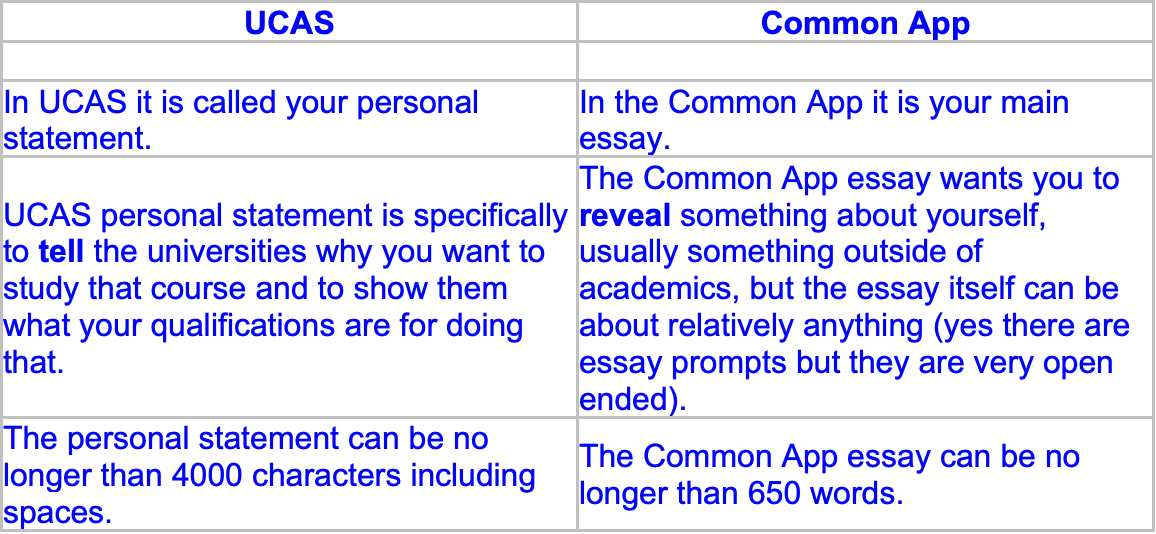
Reveal and tell are the operative words here. Revealing requires creativity more like writing a good story. Telling requires facts, more like writing a good CV and cover letter. Both are trying to convince a university to admit you but if you want to think of it in a fun way, the Common App essay is more like trying to get someone to go on a date with you and UCAS is more like trying to get hired for a job. Common App essay is an admit me because of the person I am. UCAS personal statement is admit me because my experience, skill set, accomplishments and goals make me worthy. So what makes a great UCAS personal statement? First you need to research your course selection and really know and understand what you are applying for at each College/University. The same subject can vary greatly from College to College and you need to write a personal statement that will cover those similarities and differences and show that you fully understand what you will be studying. Next let’s cover the requirements. I think the best personal statements are usually 3 parts where the middle is the most important and twice as long as the other parts.
The first part:
- should show you understand the course you are applying to study
- should show your suitability, enthusiasm and passion for the subject or in other words why the subject is important to you
- should show why you want to study that particular course
- Should tell them about your goals/ambitions as they pertain to the course
If you are International: You should include here why you want to study in the UK and if you can why that course in the UK. You can tell them what about being an International student appeals to you. Also if you are from a non-English speaking country this first part is the place to tell them your qualifications for studying in English.
The second part: Academics
- should tell them why you are a good candidate for studying that course/subject
- you should provide evidence of your skills, experience, passion for that subject and/or any extra knowledge you have in that subject
Information to include here:
-any pertinent to the course significant studying you have done inside or outside of school
- any extra reading you have done outside of class-be specific and use names
- any work experience volunteer or otherwise , or job shadowing that is pertinent to your course subject
- any club, sports team, interest, or extracurricular activity that is pertinent to your course subject
- any trip, lecture, or exhibition that you experienced that is pertinent to your course subject
- should tell them what you and your experiences will add to the classroom discussions on your subject
The third part:
- should tell them what you will add to their universities as a whole- you should share appealing personal information about yourself
- discuss extracurriculars that might be outside of your course subject that will also show transferrable skills and state how those skills will relate back to your subject. Also discuss how those extracurriculars will add to the university as a whole, like playing on a sports team
Things to keep in mind:
- Avoid clichés
- You should start and finish with strong sentences- Be specific but be concise. You only have 4,000 Characters
- Remember that this is the same statement for every College/University you apply to so do not mention a particular university
- Never lie or copy someone else’s work- Constantly be linking every point back to why you want to study that course or why you want to study in the UK
- Writing a great personal statement takes time. Expect to write several drafts before you are done. So write this first on your computer and then copy and paste it into UCAS
Here are a couple of links of sites you might find helpful:
How to write a great personal statement from the University of Birmingham

Thinking about a GAP year
Here is an excellent article from Inside Higher Ed on the complexities of thinking about a GAP year because of COVID 19 and a worry that colleges will be online in the fall.
Things to consider:
- You must be approved to take a GAP year.
- What will students be approved to do for their GAP year if COVID 19 prevents lots of things from happening?
- Online internships or isolated domestic experiences might be your best GAP options this year.
- Students at more selective institutions might have an easier time getting approved for a GAP year and extended time to make a decision.
- Most colleges will not allow you to take many courses, if any, elsewhere during a GAP year.
- Students less concerned about "getting in" to their school again might be more inclined to not commit to any school and just decide on a community college closer to home for a year and then transfer.
- Currently, the US is not processing any visas for International Students, and it could possibly be until September before they do.
- Many colleges can not afford to let many students take a GAP year, and they might limit the number of students they give permission to.
Summer thoughts for our students

I truly feel for our college students in the times of COVID 19. Most of them went from living on their own with their best friends to living at home again with their families. That is one thing but then put on top of it not leaving their homes, practically ever, taking online classes, with for many minimal directions, and then the colossal worry that is a global pandemic. It is hard enough for us parents to understand, and we have had many more years of experience in learning to cope with life’s challenges. Everyone is worried about how our young people are coping and also concerned about getting them active and thinking about the future. I keep hearing from friends how their children have turned into vampires, only awake at night. It’s funny, but it is not.
What happens once classes are over in the spring? Most of our children’s summer plans have been canceled. What are these young people going to do? What happened to high school summer programs and college internships? Now is when we have to get creative. It does not matter if your child is in high school or college; people will want to know what they did during this time. Colleges will look at high school students and say is this someone I want on our campus? Did your child sit home watching Netflix all summer eating Ben and Jerry’s, or did they do something creative and productive? Future employers are going to ask the same question of your college students. Some of you will ask why can’t we just let them be? You can, but I genuinely feel if your child spends some of their time doing something helpful, they will serve their future better and feel better in the present. This is a very hard time, and what each of us does determines how hard it will be. So what are some things they can do?
I am working with one student who is a beautiful singer. She and others have been singing outside of nursing homes. I am sure it does as much for their psyche as it does for the seniors who gather at their windows to see and hear those beautiful, healthy young people. I heard another story of a California friend’s high school student whose robotics club used their 3D printers to create shields as PPE for their local health care workers. That is true genius and an amazing use of time. Parents, please help your child think of their skill set and what they can do to be both productive and valuable right now. I guarantee it will not only help others but also make them and you feel a lot better.
SUMMER PROGRAM/INTERNSHIP INFO FOR COLLEGE AND HIGH SCHOOL STUDENTS
7 Tips to Transform a Cancelled Summer Internship due to Coronavirus into a Career-Building Opportunity Article in Thrive Global By Meghan Pasricha, Co-Founder & CEO at Global Youth H.E.L.P. Inc.
What to Do Now That Your Summer Internship is Cancelled: Article from Forbes listing online summer options for students to think about.
Opportunities for Volunteerism from Home: List of virtual volunteer opportunities for students to consider.
iXperience: Innovative summer programs that teach in-demand skills blended with internship experience, online or abroad.
Internship Status for 2020: Crowd-sourced list of the hiring/internship status for hundreds of national and global companies.
Unemployment Fears: A COVID-19 Job Search Webinar for 20-Somethings: April 28th webinar providing tangible job-search strategies for young adults furloughed/recently notified of a job loss brought about by COVID 19.
Coronavirus is upending summer internships — how to make your mark if your internship is now virtual Article from Marketwatch on what to do when your summer internship is canceled. It will come down to creativity
50 Awesome Extracurricular Activities You Can Do At Home A blog post from College Vine for high school students.
Also, please check out our new website page of higher education resources during COVID 19.
What Colleges are thinking about opening up in the fall.
Interesting OP ED in the NY Times today about the need for students to return to college and un,iversities this fall. I do not know what others are hearing, but I have heard everything from schools shutting down until January, to classes online, to both classes online and in person, to schools being open but not allowing any of their students to study abroad, to most schools still in a holding pattern.
Here is a great thread from Twitter that complies statements from different colleges on what they are thinking for the fall.
It is a crazy world right now. What do you want your college to do in the fall?