
Dear Parents of the Class of 2030
Dear Parents of the Class of 2030,
Congratulations on raising your amazing children. You have so much to be proud of. Your kids have worked incredibly hard, not just on their applications but for over 3 years studying, challenging themselves in many ways and making an impact in their communities. This is a great time before they hear back from the majority of their colleges to remind your children how well they have done and whatever decision they receive is not going to define them. They are all qualified for the institutions where they have applied and each place would be lucky to get them. Tell them they have done enough, worked hard enough and that there is nothing left to do. Yes, I said nothing. It is time for your kids to cut themselves a break and realize this is not all about them, but about whatever the college might need. Colleges are businesses and operate like such. They are concerned about putting together a whole class. Who gets accepted to a college is less about individuals and more about that college’s institutional priorities. So, what are often some institutional priorities?
A) Colleges need to manage their enrollment.
Colleges have had a huge spike in applications since the pandemic. Last year’s 2024-2025 cycle a total of 1,498,199 first-year applicants submitted over 10 million applications, a milestone high volume, to the over 1,097 member institutions who use the Common App. These numbers have been steadily rising for over 5 years now and so far despite concern about the enrollment cliff, this year applications to the Common Application’s 916 returning members (colleges that have used the Common App for more than five years) increased another 5% for a total number of applications through November 1st of 962,284. Since 2020, the number of applications to Common App institutions has risen by almost 94%, and the number of applicants has risen by almost 49%. Simply put, more students are applying to colleges through the Common App, and because of that and the ripple effects of the resulting dropped admissions rates, some students are applying to more colleges than their counterparts did 5 years ago. The exception to this is international students. International student enrollment is down 17% this year because the current administration is making it difficult for students to obtain visas to study here. Early international applicants are down 9% from last year at this time. If international applications do not increase this will affect admissions, especially at institutions with larger international populations who count on those usually full pay students.
Colleges are trying to have a set number of students in each class. Their class size is determined by many things, but among them might be: how much money they need to earn from tuition; how much space they have for students to live on campus; how large their other classes are; how many students they feel they can comfortably educate and serve. Hitting this exact number is tricky, especially these days. Colleges are making educated guesses on which applicants that they have accepted might actually attend and become part of their class. This delicate calculation is the job of a college’s enrollment manager. Some years, colleges do a great job predicting this number, and some years, they do not. Some colleges might have over-enrolled or under-enrolled last year or for more than one year, so they need to take fewer or more students overall this year. This is also where a college’s waitlist comes into play. Colleges use their waitlist as insurance to hit their desired enrollment numbers. Last year when many international students who were accepted to institutions either could not get visas to come here or changed their mind about wanting to study here we saw an enormous amount of waitlist action and increased merit aid offers. Syracuse University, whose enrollment is typically over 11% international, went on an unprecedented spree offering qualified domestic candidates who had turned down their offer of admissions very large merit aid packages to change their minds.
So, why would a college take more or fewer students than in previous years? A college is managing its yield. Yield is the rate at which a college’s accepted students choose to enroll. According to the advocacy group Class Action, “In 2023, the yield rate for all colleges was 21%, half of what it was in 2001. This falling yield rate is a product of more students applying to more colleges. While most people still apply to just a couple of colleges, the students who apply to highly selective ones tend to spread their bets. In 2014, 8 percent of applicants using the Common Application sent out 10 or more applications. In 2021, 17 percent did, and the average applicant to a highly selective private college applied to 11 other institutions.”
Other things can come into play when a college over-enrolls - a college might not have adequate housing for so many students. The University of Connecticut, Storrs campus, recently grew its enrollment numbers from 18,917 in the fall of 2020 according to the university’s annual fact sheet to a preliminary enrollment number of 20,500 in the fall of 2025. While they eventually found housing for everyone there were many upset students and families who had to bear the significant extra expense of finding off campus housing. U Conn will have to either obtain more housing for students, drop their 4-year housing guarantee or enroll a smaller class for a few years.
To manage enrollment, a college might enroll a large percentage of their class earlier in EA, ED I or ED II. Again according to Class Action, “Although ED remains relatively rare and the number of institutions offering it has not grown much in the past decade, the degree to which some highly selective colleges and universities rely on ED to enroll a significant percentage of their undergraduates has increased. The number of colleges and universities that admit more than 40% of their enrolled freshmen through ED—73 in total—has grown by almost 50 percent since 2015.” Please look at the chart below for how much ED has increased at many institutions. Of particular note is Northeastern which went from enrolling 9% of their class to 54% of their class ED and BU which went from enrolling 20% of their class to 61% of their class ED. Also of note is that many colleges who do not have ED enroll a large percentage of their class EA. Penn State often fills up their entire University Park campus with EA applicants, and the University of Maryland, College Park typically fills 90% of its incoming class in the EA round. At these colleges and many others, it simply becomes way harder to get accepted regular decision.
From Class Action, “What Percentage of the Freshman Class is Enrolled through Early Decision, 2015 vs 2024
The percentage was calculated by dividing the number of early decision (ED) admits by the total enrollment. This calculation is an approximation of the actual percentage of the class admitted through ED, since some ED admittees may not enroll. The Common Data Set does not collect data on ED enrollments. Due to space limits, this chart only includes institutions where 40 percent or more of the class was enrolled though ED. Here is a link to the full set of data.”
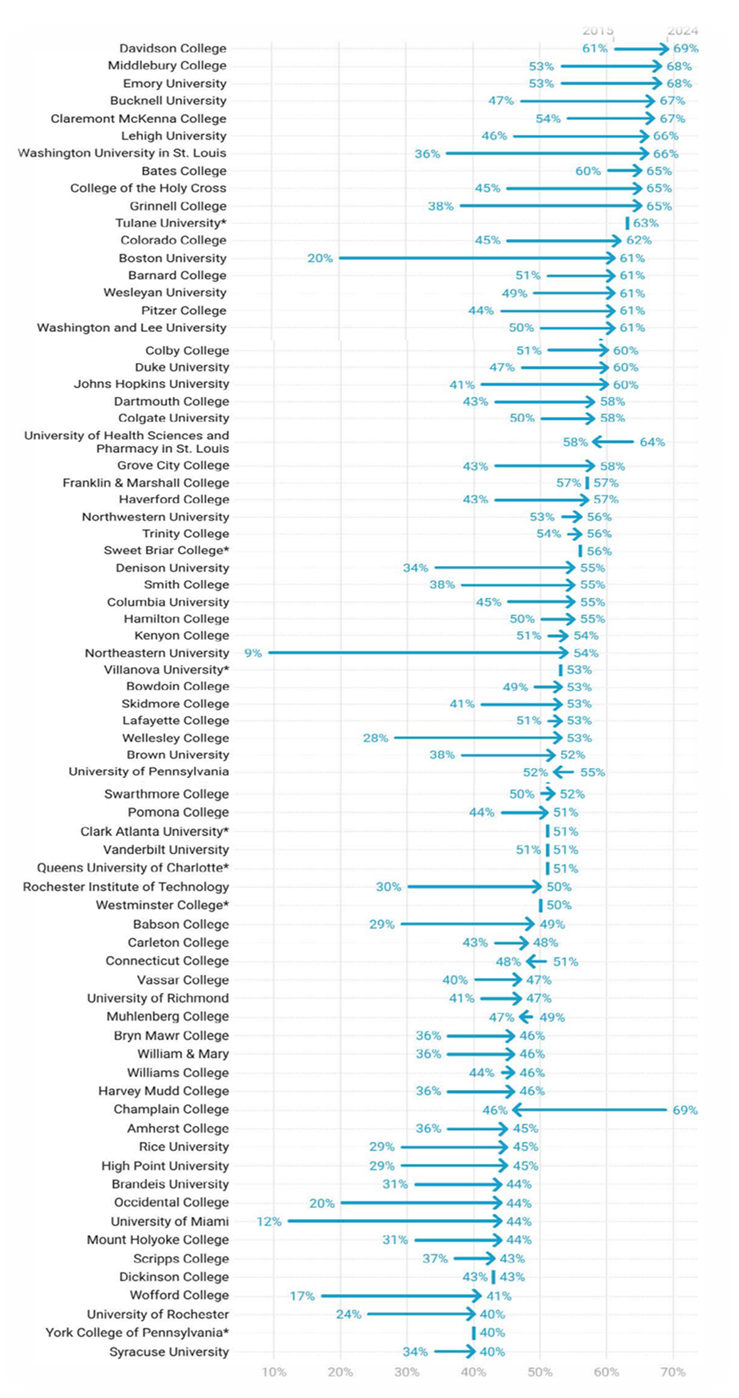
*=Institutions that did not have an ED program in 2015. **=Institutions for which 2015 data were not available, so data for 2016 were used instead. ***=Institutions for which no data were available for 2015 or 2016.
Chart: James S. Murphy - Source: Common Data Set - Created with Datawrapper
Colleges must balance their budgets. This year with the “Dear Colleague Letter," the dismantling of the Department of Education, higher taxes on large endowments, budgets cuts to agencies that provide research dollars, the Compact for Academic Excellence in Higher Education which was sent to nine institutions and expanded to all universities, plus the current administration’s blocking of international student visas there is huge concern about the current administration’s threats to withhold federal funding that has many colleges concerned about their budgets. Many institutions, even highly selective, wealthy ones like several of the Ivies, have hiring freezes in place. Some colleges may need to accept more full-pay students to help them balance their budgets and/or achieve other goals. Several colleges, including highly selective ones like Stanford and Duke made offers to waitlist students as late as August of this year and we think in part to help balance their budgets. Other colleges that have large international populations like BU and USC took more students this year than last year. For the class of 2029 according to their announcements with their regular decisions last spring, BU accepted 9,059 and USC accepted 8,700 students. Compare this to last year when they accepted 8,414 students and 7,750 students, respectively.
Perhaps Columbia is the best case example here. Columbia enrolled its largest incoming class of undergraduates ever this fall with about 20% more students in the Class of 2029 compared to the Class of 2028 (1,806 vs 1,499). Columbia has come out and said they are considering keeping this larger size for future classes and will make a final decision within the next month. In July, Columbia agreed to pay $221 million to settle investigations into alleged violations of anti-discrimination laws, in return for the reinstatement of the majority of federal research grants that had been withheld by the current administration. They also have a large population of international students - 17% of their undergraduates. Columbia’s acting president cited research funding and international student enrollment as “two big risk factors” they are considering in their decision-making process, in addition to successfully graduating their largest class to date last May. These changes are especially significant when you consider many of the universities who’ve been increasing their class sizes are located in cities and cannot easily make changes to accommodate more students, as well as the fact that their class sizes have been relatively fixed for a long time.
Some colleges are prioritizing Pell-eligible, first-generation or low-income students. Many highly selective universities are partnering with community based organizations like QuestBridge College Match Programs to find these students. According to the Harvard Crimson, 20.5 percent of Harvard’s admitted students to the Class of 2029 are Pell eligible and 20.3 percent will be the first in their families to go to college. Duke admitted a record high of 113 students ED to their Class of 2029 through the QuestBridge National College Match Program.
Some colleges prioritize letting in the majority of students with some type of tuition discount. This is the very concept of merit aid. An example is Lake Forest College, which offers merit aid to 100% of accepted students. Another example is Syracuse who has already come out publicly in their school newspaper The Daily Orange and said they plan to make stronger merit aid offers earlier in the cycle this season in order to get the desired number of students enrolled in their class.
Some public colleges must prioritize in-state students. For example, the state of North Carolina mandates that any UNC campus can only have a maximum of 18% of its incoming class coming from out of state. Some states auto-admit a large percentage of in-state students. A good example of this is the University of Texas, Austin, which automatically accepts applicants who rank in the top 5% of students of their Texas high school class (UT Austin is also required by state law to have 90% of its first-year class consist of in-state students.)
Some public colleges may need out-of-state students or, moreover, need money from out-of-state student tuition. Good examples of this are the University of Vermont and the University of Delaware. Neither state has enough students in-state to fill its flagship university.
Some colleges prioritize certain groups like military families with things like yellow ribbon benefits and children of academic employees with tuition exchange programs. As an example, SMU and Villanova offer full tuition scholarships to 100 students via yellow ribbon benefits.
Colleges will often accept students with connections to VIPs or the college’s Development office.
Some colleges will prioritize Legacy students. Five states have enacted laws restricting legacy admissions, California, Illinois, Maryland and Virginia in 2024 and Colorado in 2021. 24% of four-year colleges/universities currently consider legacy status, which is down from 29% in 2022 and 49% in 2015. 11% of public (62) and 30% (358) of private colleges/universities consider legacy status in their admissions process. Legacy preferences remain the strongest at the most selective colleges and universities, with more than half (56%) still providing an advantage to the relatives of alumni. Some colleges that really still favor legacy are the Jesuit colleges, Dartmouth, Duke and Vanderbilt, among others.
B) Colleges have athletic teams, school bands, school choirs, debate teams, and theater productions.
Colleges might need to fill an athletic spot. Smaller schools field almost the same number of teams and the same number of roster slots as larger schools. In smaller schools, filling teams can account for ¼-⅓ of the incoming class.
Colleges might need a student who plays an obscure instrument.
College might need a student with all sorts of special talents.
C) Colleges want students in all of their different majors.
This might mean that certain popular majors are much harder to get into than others. For example, Business and Engineering are very impacted majors in the country right now, meaning more students want to study them than colleges often have space to accommodate. Some majors, like Nursing, are not only popular but also constrained by the availability of clinical space.
Some colleges might need to consider that a department is understaffed or unprepared to take students at this specific time.
Some colleges will prioritize certain genders for certain majors. For example, male students might have a strong advantage in fine arts and fashion. When we visited Rensselaer Polytechnic last year, they spoke candidly about wanting to enroll more women engineers, while the University of San Diego spoke proudly about equalizing the gender imbalance among their engineering students.
D) Most colleges want to have a diversified class of students.
Colleges want students with diversified interests in and out of the classroom.
By now, you’ve probably heard about the 2023 Supreme Court ruling against the race-conscious admissions programs at Harvard and the University of North Carolina (and, by extension, other colleges with similar programs). All colleges, except the military academies, currently ban affirmative action in admissions. Some words from the Court’s opinion that we believe are being closely followed by college admissions offices: "nothing in this opinion should be construed as prohibiting universities from considering an applicant's discussion of how race affected his or her life, be it through discrimination, inspiration, or otherwise. But, despite the dissent's assertion to the contrary, universities may not simply establish through application essays or other means the regime we hold unlawful today." In their applications, we still encourage students to write about how their background influenced them, because universities are free to consider “an applicant’s discussion,” and we believe most colleges are still committed to creating an ethnically diverse class.
Some colleges want a regionally diverse group from all 50 states and multiple international locations. Colleges might be trying to expand their footprint regionally, nationally, or internationally. They might prioritize one location over another. Every time I am on a college tour, I laugh at the requests for students from the Dakotas.
Some colleges might want students from more rural or underserved locations. In anticipation of the 2023 Supreme Court decision and looking for alternative ways to create a diversified class, 16 prominent colleges, including Yale, Harvard and Columbia formed the Small Town and Rural Students College Network (STARS.) STARS has helped colleges identify and recruit more rural students than ever before.
Some colleges want a good gender balance and prioritize men over women or vice versa. This article shows how at Brown, men have an advantage in the admissions process because Brown simply gets way more applications from women. In general, for the highly selective colleges, we have seen men having an easier time than women. An exception to this would be the UC system, which does not consider gender.
Some colleges want a class that is diversified in sexual orientation, so they might prioritize underrepresented groups like LGBTQ students.
Some colleges prioritize first-generation students or students who are re-entering college. The UCs are a good example of this.
Some colleges, especially religious ones, may want a certain percentage of their students from their specific denomination/churches.
Some colleges prioritize students who were in the military.
E) Some colleges prioritize their relationships with certain high schools.
F) Some colleges are prioritizing rankings and making decisions that maximize their place on US News and World Report. This is part of a larger conversation and probably best left for another day, but when you have time, look into how US News and World Report ranks colleges. Much of that data can be manipulated through recruitment and enrollment tactics, including yield protection.
The true trick to acceptance for many students is when they fulfill multiple priorities of a college. For those of you with children who have already applied and those whose children have yet to apply, please remember this: if the decision is no, it is often not your child, it’s the colleges.
So this holiday season, please celebrate your children and tell them how proud you are of all that they have done and who they have become. This is one of those critical parenting moments where we can not control the outcomes but we can control our reactions to the outcomes. Ask family members to please not let the conversation turn to college this Thanksgiving. Some students have already received a great acceptance and some are anxiously waiting. Others are still finding their way. Wherever you or your child is in their journey, it is their business. Do not let your well-meaning relatives and close friends add to the stress. Maybe even reach out before you arrive at a gathering to ask friends and family to, in the words of my dear friend College Marni, "leave college discussions off the menu.” Happy Holidays to all and thank you to so many of you for letting us be a small part of your children’s lives.
Thank you to my colleague Meg Joyce for co-authoring this blog with me. It takes a village…